Christian’s Dental Problems Before Treatment
Christian describes his starting point simply:
“I had bad teeth and pain.”
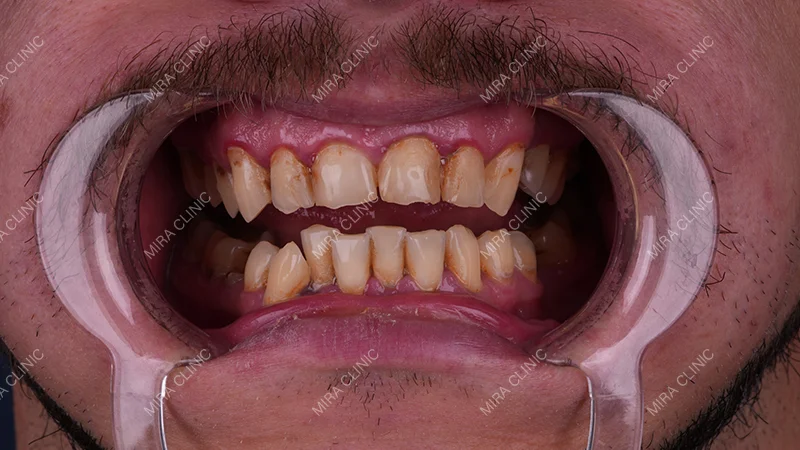
His examination provided a clearer picture of what needed treatment.
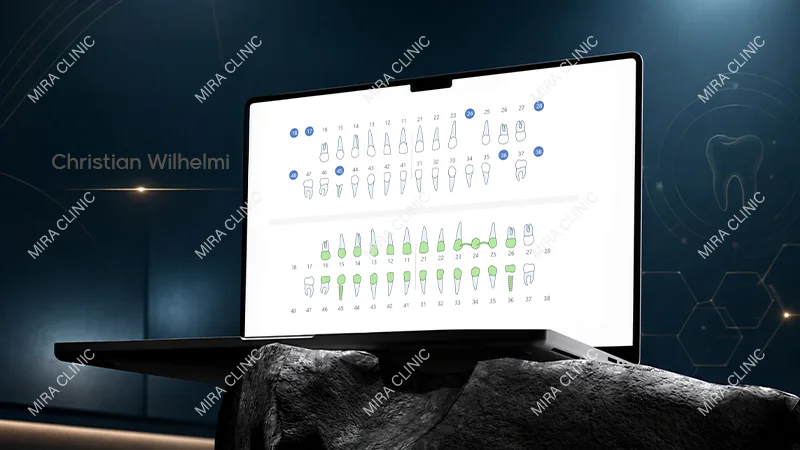
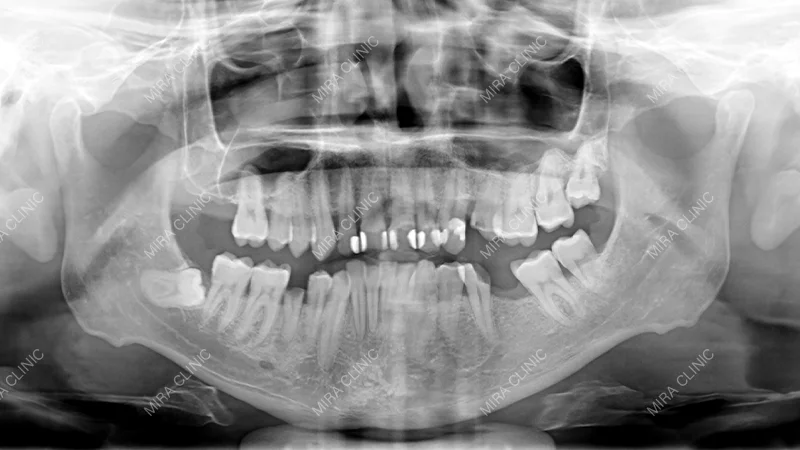
Several teeth were already missing, including teeth in both the upper and lower jaws. Tooth 45 was recorded as a radix, meaning a remaining root was present rather than a complete functional tooth.
The documented dental status included:
- missing upper teeth
- a missing tooth in the upper left side
- missing lower posterior teeth
- a retained root at tooth 45
- remaining natural teeth that could be incorporated into the restorative plan
This meant Christian needed several different treatments working together.
Some missing areas required implants.
Another missing tooth could be restored with a bridge.
The remaining teeth could then be restored with crowns to rebuild the smile as a more complete unit.
Examination and Treatment Planning
Christian says that before traveling, he requested an online consultation and received a structured treatment plan.
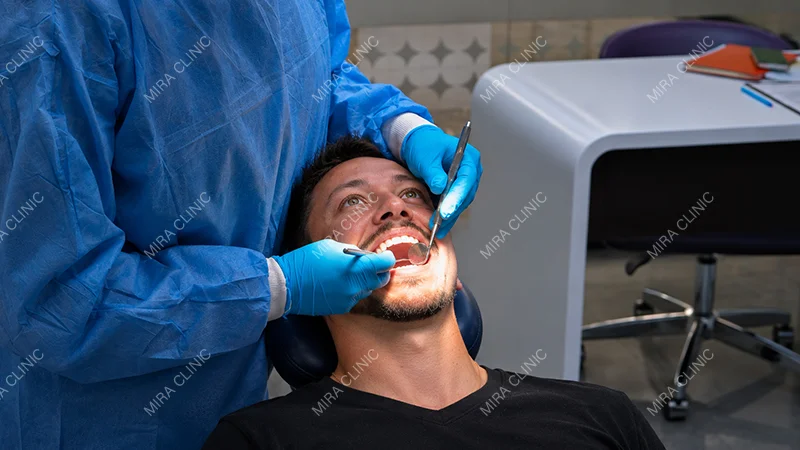
Once at the clinic, panoramic imaging and CBCT were included in the assessment before proceeding with treatment.
The final plan was built around the specific condition of different areas of his mouth rather than applying the same treatment everywhere.
It included:
- extraction of the retained root at tooth 45
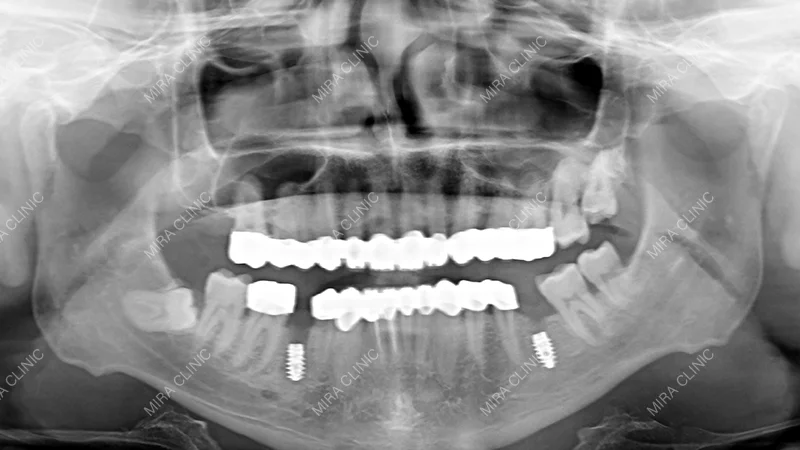
- 2 Straumann dental implants at teeth 36 and 45
- a 3-unit zirconium bridge across teeth 23, 24, and 25
- extensive zirconium crown treatment across the upper and lower arches
- final zirconium crowns for the two implants after healing
This approach addressed both the missing-tooth problem and the condition of the remaining teeth.
Removing the Retained Root and Replacing Missing Teeth
One important part of Christian’s treatment was tooth 45.
The examination identified a remaining root in that position, so the treatment plan included extraction before an implant could be placed there.
Another implant was planned at tooth 36, where the tooth was already missing.
These two areas were restored with Straumann implants.
Implants replace the root portion of a missing tooth and create a foundation for a later crown.
For Christian, they were used selectively where implant-supported replacement was needed rather than placing implants throughout the entire mouth.
A Zirconium Bridge for Another Missing Tooth
Not every missing tooth required an implant.
Christian was also missing tooth 24 in the upper jaw.
Instead of placing another implant in that position, his restorative plan included a three-unit zirconium bridge across teeth 23, 24, and 25.
This allowed the missing tooth to be replaced using the neighboring teeth as support.
His case therefore demonstrates an important principle of restorative dentistry: different missing-tooth areas can require different solutions depending on the clinical situation.
Christian’s final treatment combined implants and a bridge rather than relying on only one method.
Rebuilding the Smile With Zirconium Crowns
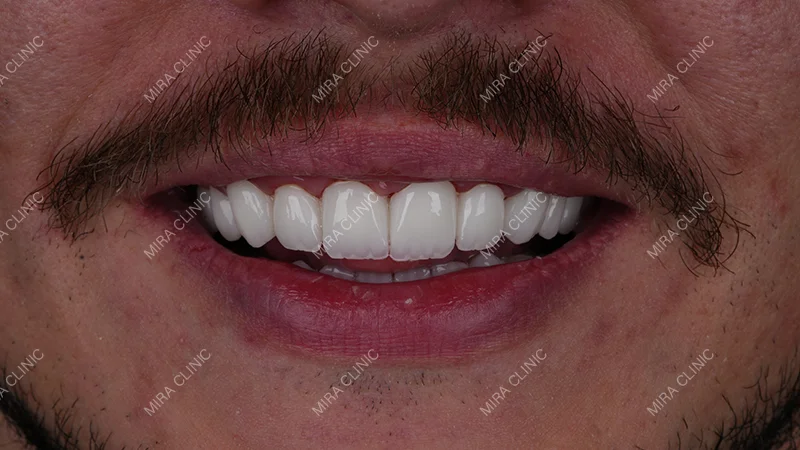
The largest part of Christian’s restorative plan involved zirconium crowns.
The plan lists 19 zirconium crowns on natural teeth, distributed across both jaws.
Together with the three-unit bridge and the two implant crowns, the final treatment represented 24 zirconium restorative units across the smile.
This allowed the dental team to coordinate more than simply individual damaged or missing teeth.
The restoration could also consider:
- tooth proportions
- crown shape
- upper and lower alignment
- bite relationships
- smile consistency
- the appearance of implant-supported and natural teeth together
For Christian, this was the difference between treating isolated problems and rebuilding the smile as a whole.
The Implant Procedure Was Easier Than Christian Expected
One of Christian’s biggest surprises was the implant procedure itself.
He says:
“The implant was actually way better than I imagined.”
He also recalls:
“It took like 20 minutes.”
Christian’s treatment plan included two implants, while his testimonial focuses on the individual implant procedure that stood out most to him.
What mattered most to him was how different the experience felt from what he had anticipated.
He says:
“I didn’t feel any pain at all.”
He also explains that pain medication was provided afterward and that he remained comfortable following the procedure.
This was Christian’s personal experience; discomfort and procedure time can naturally vary depending on the implant site and individual case.
Completing the Implant Restorations
Dental implant treatment does not end when the implant fixture is placed.
After healing, the implants need their final crowns.
Christian’s plan included two zirconium crowns at teeth 36 and 45 to complete the implant restorations.
These crowns became the visible replacement teeth supported by the implants underneath.
Once they were incorporated into the wider zirconium restoration, the implant areas could visually and functionally connect with the rest of the smile.
The result was therefore not simply “two implants.”
It was a comprehensive restoration combining natural teeth, implant-supported teeth, and a zirconium bridge within one overall treatment plan.
From Years of Pain to Showing His Family a New Smile
Christian’s reaction after treatment was immediate.
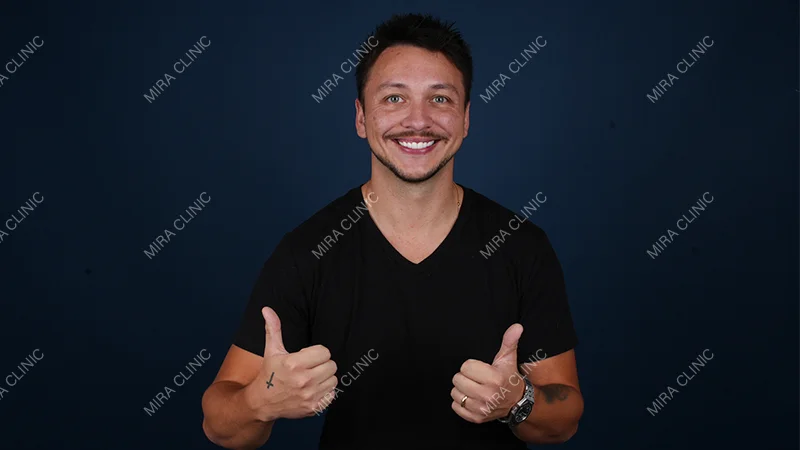
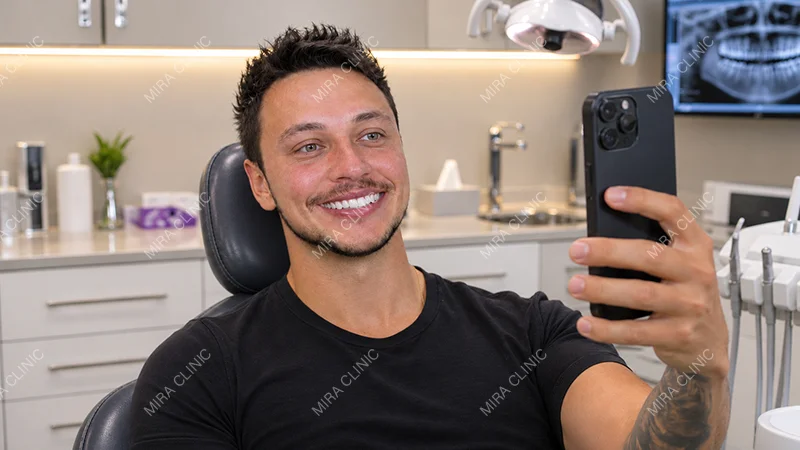
He says he called his family to show them his new smile because he was so excited.
For someone who had wanted his teeth fixed since childhood, that moment represented much more than a cosmetic change.
The treatment addressed missing teeth, a retained root, and broader restorative needs, but Christian describes the personal effect most strongly:
“It is life-changing for me personally.”
His family also noticed the result, and Christian says he began recommending the experience to them.
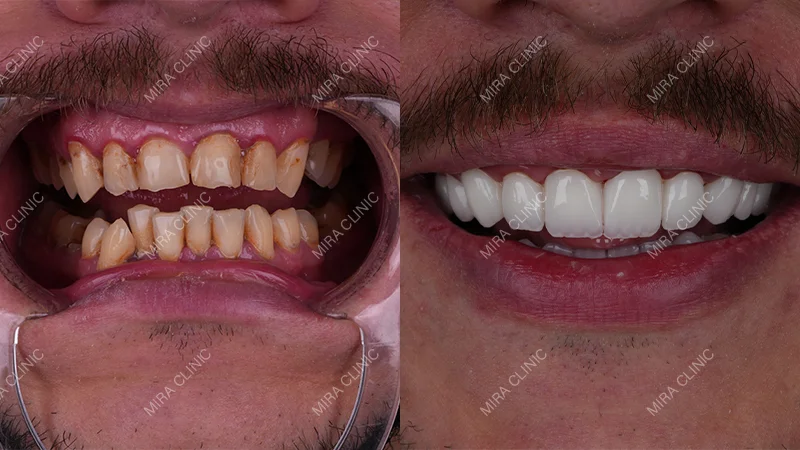
Before and After Christian’s Dental Treatment
Before Treatment
Christian’s situation involved:
- dental problems dating back many years
- recurring pain
- multiple missing teeth
- a retained root at tooth 45
- missing posterior support
- a desire to finally rebuild his smile
Treatment
His personalized restorative plan included:
- panoramic X-ray and CBCT
- extraction of the retained root
- 2 Straumann implants
- 3-unit zirconium bridge
- 19 zirconium crowns on existing teeth
- 2 final zirconium implant crowns
- approximately 24 zirconium restorative units overall
These treatments addressed different dental problems within one coordinated rehabilitation.
Result
After treatment, Christian describes:
- relief after years of dental problems
- a complete new smile
- a surprisingly comfortable implant experience
- confidence showing the result to his family
- strong personal satisfaction with the transformation
His own description summarizes the impact:
“I come home with a great smile and a great experience.”
Final Perspective
Christian traveled from Norway to Istanbul after dealing with dental problems and pain for much of his life.
His examination showed that the problem extended beyond aesthetics. Several teeth were missing, tooth 45 remained only as a root, and different parts of the mouth required different restorative solutions.
His treatment combined two Straumann dental implants, extraction of the retained root, a three-unit zirconium bridge, extensive zirconium crown treatment, and two final implant crowns.
The implant procedure he had worried about became one of the easiest parts of the experience from his perspective. He recalls that it took around 20 minutes and says he felt no pain during the procedure.
But the strongest part of Christian’s testimonial is not the procedure time.
It is the difference between where he started and where he finished.
He began with a problem he had wanted to fix since childhood.
He finished the treatment saying:
“It is life-changing for me personally.”
For Christian, the result was not simply a new set of teeth. It was the resolution of a dental problem that had affected him for years and the opportunity to return home with a smile he was finally excited to show.