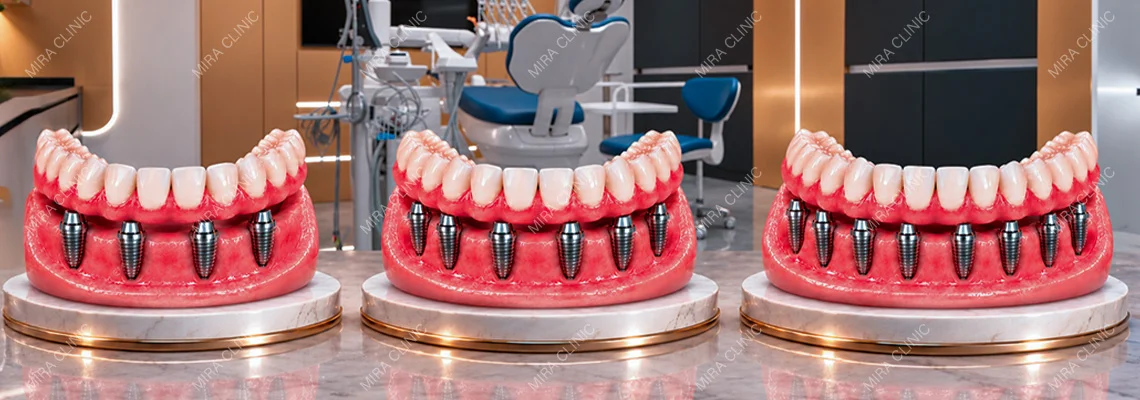
The difference between All-on-4, All-on-6, and All-on-8 dental implants is not simply the number of implants used. The right treatment depends on jawbone volume, bone quality, implant distribution, bite forces, and the type of full-arch restoration required. A dentist evaluates these factors using a clinical examination and a CBCT scan before deciding how many implants can safely support the final teeth.
Patients with worn front teeth, missing back teeth, or significant bone loss often wonder whether four, six, or eight implants will provide the strongest result. However, choosing more implants does not automatically mean better treatment.
At Mira Clinic in Istanbul, full-mouth dental implant planning begins with understanding the condition of the remaining teeth and jawbone. The goal is to select an implant configuration that provides suitable support while avoiding unnecessary surgery and preserving natural teeth whenever possible.
- All-on-4 vs All-on-6 vs All-on-8: What Is the Difference?
- How Do Jawbone Thickness, Density, and Bone Loss Affect Implant Choice?
- How Does a CBCT Scan Help Dentists Choose the Number of Implants?
- When Would a Dentist Recommend All-on-4, All-on-6, or All-on-8?
- Case Examples: Worn Front Teeth, Missing Back Teeth, and Severe Bone Loss
- Does Choosing More Implants Improve Stability, Cost, and Long-Term Results?
- How Mira Clinic Plans Full-Mouth Dental Implants in Istanbul
- Final Verdict: Which Is Better, All-on-4, All-on-6, or All-on-8?
All-on-4 vs All-on-6 vs All-on-8: What Is the Difference?
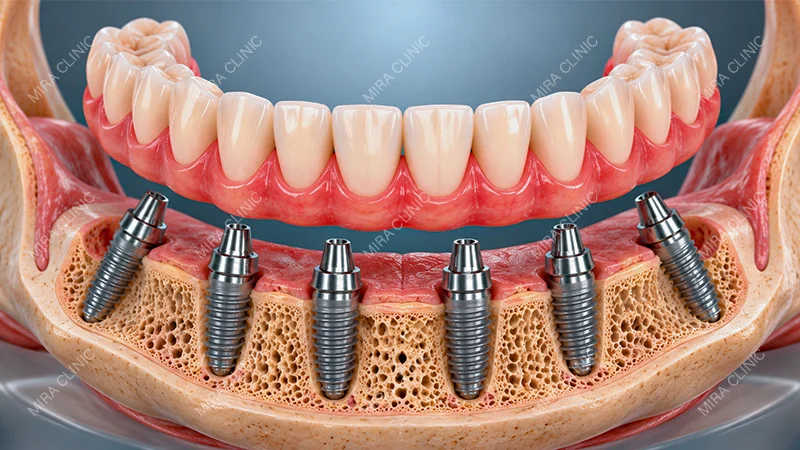
All-on-4, All-on-6, and All-on-8 are full-arch dental implant treatment approaches. They use multiple implants to support a fixed restoration replacing the teeth in one jaw.
The main difference is the number of implants supporting the final prosthesis. However, their suitability depends on implant positioning, available bone, and the forces that the restoration must withstand.
|
Treatment |
Implants per jaw |
Main clinical consideration |
|---|---|---|
|
All-on-4 |
4 |
Four strategically distributed implants supporting a full-arch restoration |
|
All-on-6 |
6 |
Additional implant positions may improve support distribution when anatomy permits |
|
All-on-8 |
8 |
More implant positions may be considered in selected extensive restorations with adequate anatomical space |
These descriptions do not represent a universal ranking from weakest to strongest.
A well-planned All-on-4 restoration may provide appropriate support for one patient, while another may benefit from six implants because of the available bone distribution, bite forces, and final bridge design.
Likewise, eight implants are not necessary for every full-mouth case and cannot compensate for unsuitable implant positions or poor bone support.
The dentist must also distinguish between restoring a completely toothless jaw and treating a patient who still has natural teeth worth preserving.
If several teeth remain healthy, full-arch extraction and replacement may not be the most appropriate treatment.
How Do Jawbone Thickness, Density, and Bone Loss Affect Implant Choice?
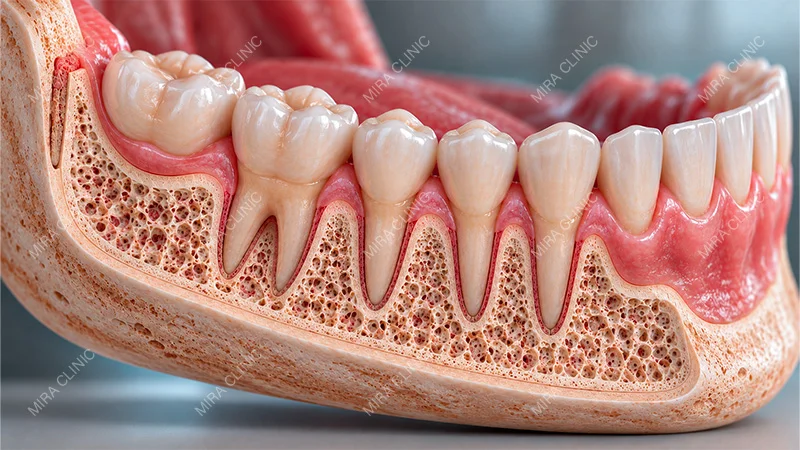
Jawbone anatomy is one of the most important factors in full-mouth dental implant planning.
Dental implants require sufficient bone support for stability, but the decision involves several measurements rather than one simple bone thickness threshold.
Bone Thickness and Height
Bone thickness generally refers to the available width of the jawbone, while bone height describes the vertical space available for implant placement.
An implant needs suitable surrounding bone and must be positioned safely in relation to important anatomical structures.
If a patient has lost back teeth for many years, the surrounding jawbone may have become narrower or shorter.
This can limit where implants can be placed and influence whether four, six, or eight implants are technically appropriate.
For example, a patient may have sufficient bone in the front of the jaw but limited bone in the posterior areas.
A dentist might consider a four-implant configuration using strategically angled posterior implants when the anatomy and prosthetic plan support it.
Another patient may have enough bone distributed throughout the arch to accommodate six implants in suitable positions.
The decision is based on safe placement and functional support, not simply the desire to use more implants.
Bone Density and Implant Stability
Bone quality also affects implant treatment.
Some regions of the jaw provide denser bone than others. Bone structure can influence the mechanical stability achieved when an implant is inserted.
However, density alone cannot determine the appropriate number of implants.
Implant dimensions, distribution, stability, loading protocol, and the final prosthetic design must also be evaluated.
A CBCT scan can help visualize bone anatomy and morphology, but its grayscale measurements should not be treated as universally reliable absolute bone-density values.
The surgeon combines imaging findings with clinical assessment and information obtained during treatment.
Bone Loss in the Back of the Jaw
Patients who have been missing molars for several years may experience significant posterior bone loss.
In the upper jaw, the maxillary sinus can limit the available vertical bone.
In the lower jaw, the inferior alveolar nerve and other anatomical structures must be considered.
These limitations may affect implant positions and lead the dentist to consider angled implants, shorter implants, bone augmentation, or a different restoration design.
Importantly, severe bone loss does not automatically mean that All-on-4 is always the best choice. Some patients may require additional surgical techniques or alternative treatment approaches.
How Does a CBCT Scan Help Dentists Choose the Number of Implants?
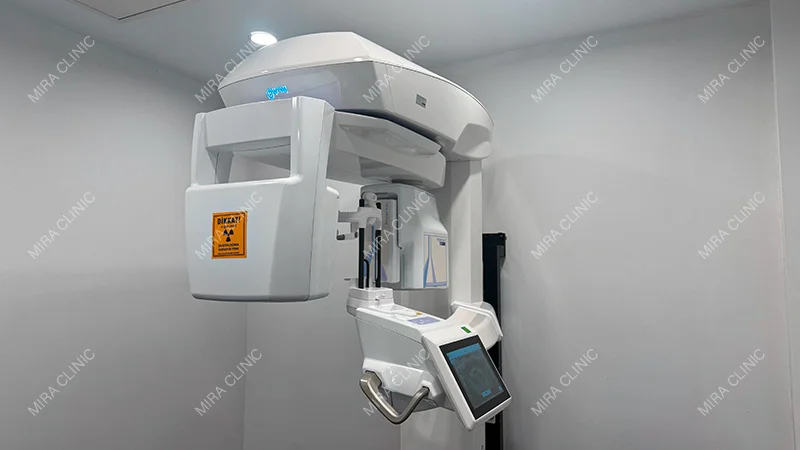
A CBCT scan provides three-dimensional information about jawbone anatomy and the structures surrounding potential implant sites.
For full-arch implant planning, it is an important tool because the dentist must determine not only whether implants can be placed, but also where they should be positioned to support the final teeth.
What Can a Dentist See on a CBCT Scan?
A CBCT scan can help assess:
- Jawbone height and width
- Shape of the residual bone ridge
- Areas of significant bone loss
- Position of the maxillary sinuses
- Location of relevant nerves and anatomical structures
- Available sites for implant placement
- Bone defects that may require augmentation
The dentist uses this information alongside the clinical examination and the final prosthetic plan.
A CBCT scan cannot independently decide whether a patient requires All-on-4, All-on-6, or All-on-8.
It provides anatomical information that helps the dentist make that decision.
How Implant Distribution Affects the Final Bridge
The positions of the implants are often as important as their number.
A full-arch bridge must distribute chewing forces through the implants and supporting bone.
If implants are concentrated too closely together, certain sections of the bridge may extend beyond the outermost implants.
These extensions are called cantilevers.
Their length and the forces acting on them must be considered during treatment planning.
A configuration with fewer appropriately distributed implants may be preferable to placing more implants in positions that do not provide useful additional support.
Why the Dentist Makes the Final Decision
Patients may arrive at the clinic already requesting All-on-6 because they believe it is stronger than All-on-4.
However, the dentist may find that four implants offer suitable support for the planned restoration.
The opposite can also happen.
A patient may request All-on-4 because it appears more affordable, but the imaging, bite, and prosthetic assessment may support a six-implant design or a more complex treatment plan.
The treatment recommendation should follow the diagnosis, not the package name.
When Would a Dentist Recommend All-on-4, All-on-6, or All-on-8?
The decision between these treatments depends on the available implant positions, bone support, opposing teeth, expected chewing forces, and final bridge design.
The dentist also considers medical history, gum health, oral hygiene, and whether immediate temporary teeth are suitable.
When All-on-4 May Be Recommended
All-on-4 may be considered when four implants can be placed in positions that provide suitable support for a fixed full-arch restoration.
In selected patients, posterior implants may be angled to utilize available bone and reduce the need for certain bone augmentation procedures.
This can be useful when posterior bone is limited, but the remaining anatomy allows stable implant positioning.
All-on-4 is not automatically a treatment reserved for patients with poor bone quality.
It is a full-arch support concept that must meet specific anatomical and mechanical requirements.
When All-on-6 May Be Recommended
All-on-6 may be considered when the patient has suitable bone distribution for six implants and the treatment plan benefits from additional support positions.
Six implants may allow more flexibility in prosthetic design and load distribution in selected cases.
However, the additional implants should provide a meaningful clinical benefit.
If the extra implant positions require extensive grafting or are poorly located, they may not automatically improve the treatment.
When All-on-8 May Be Recommended
All-on-8 may be considered for selected full-arch restorations where the dentist identifies appropriate implant positions and a prosthetic reason for using eight implants.
A larger number of implants may allow different restoration configurations, including certain segmented designs.
However, eight implants require sufficient anatomical space and suitable placement sites.
The added implants also increase the number of surgical and prosthetic components requiring maintenance.
For these reasons, All-on-8 should be recommended based on a specific clinical indication rather than presented as the premium choice for every patient.
Case Examples: Worn Front Teeth, Missing Back Teeth, and Severe Bone Loss
Patients with similar-looking smiles may have very different conditions beneath the gums.
The following illustrative scenarios explain why the dentist must examine the teeth and jawbone before recommending full-arch implants.
Case 1: Worn Front Teeth and Missing Back Teeth
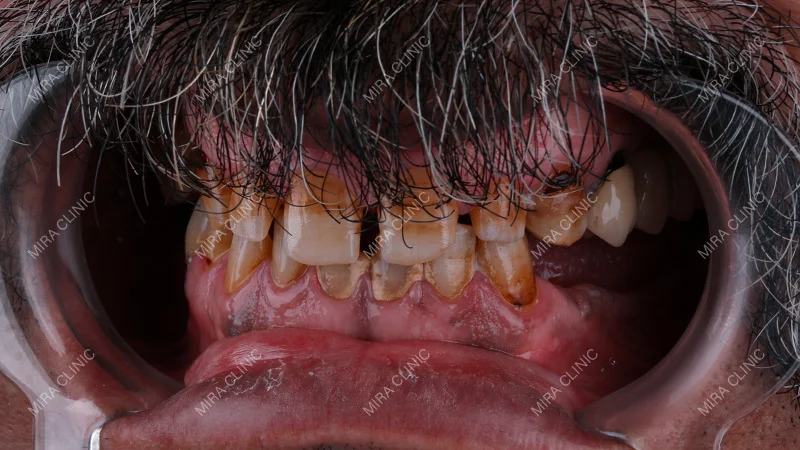
A patient has severely worn front teeth and has been missing several back teeth for years.
The patient believes that full-mouth implants are needed because chewing has become difficult and the smile looks damaged.
However, clinical examination may reveal that some front teeth remain restorable with crowns or other treatments.
A CBCT assessment may show adequate bone for individual implants or an implant-supported bridge in selected posterior regions.
Possible decision: Preserve suitable natural teeth and replace only the missing teeth rather than extracting the entire arch for All-on-4, All-on-6, or All-on-8.
This may reduce unnecessary treatment while restoring chewing support.
Case 2: Most Teeth Cannot Be Preserved, With Limited Posterior Bone
Another patient has widespread tooth damage, multiple failing teeth, and substantial bone loss in the back of the jaw.
After determining that a full-arch restoration is appropriate, the dentist evaluates the remaining bone.
If suitable anterior implant positions and safe posterior angulation are available, an All-on-4 approach may be considered.
However, the surgeon must also determine whether sufficient implant stability can be achieved and whether the planned bridge can be supported appropriately.
Possible decision: A four-implant full-arch treatment, additional augmentation, or another implant configuration depending on anatomical findings.
Case 3: Extensive Tooth Loss With Favorable Bone Distribution
A patient has lost most teeth in one arch but retains suitable bone volume in several anterior and posterior regions.
The dentist evaluates how the implants could be distributed beneath the planned final restoration.
Six implants may provide suitable support and prosthetic flexibility.
Eight implants might be considered if the restoration design and anatomy justify them, but this does not mean they are automatically necessary.
Possible decision: All-on-6 or another clinically justified configuration based on implant position, bridge design, and bite forces.
These examples show why a patient cannot reliably determine implant number by looking at the teeth in a mirror or comparing dental package prices online.
Does Choosing More Implants Improve Stability, Cost, and Long-Term Results?
More implants can offer additional support opportunities in certain situations, but a higher implant count does not guarantee better outcomes.
Clinical research has reported comparable implant survival between some four-implant and six-implant fixed full-arch designs.
The final result depends on several factors working together.
Chewing Pressure and Implant Distribution
When patients chew, the prosthesis transfers forces through the implants to the surrounding bone.
The dentist must consider where those forces occur and how the final bridge is supported.
For patients with strong bite forces, bruxism, or opposing natural teeth, the prosthetic design may require special attention.
Depending on the case, additional well-positioned implants can provide benefits, but the final recommendation must consider the complete mechanical situation.
Does All-on-8 Cost More Than All-on-4?
All-on-8 generally involves more implant components than All-on-4 and may result in higher surgical and restorative costs.
However, total treatment cost depends on much more than implant count.
Relevant factors include:
- Implant brand and components
- Extractions and surgical complexity
- Bone grafting or sinus lift requirements
- Temporary teeth
- Final bridge material
- Laboratory work
- Number of treatment visits
- Follow-up and maintenance needs
Patients should compare complete treatment plans rather than assuming the highest-priced package offers the most reliable outcome.
Long-Term Maintenance and Implant Health
All full-arch implant restorations require maintenance.
Patients must clean beneath the bridge and attend professional examinations to monitor the gums, implants, and prosthetic components.
Inflammation around implants, mechanical complications, and changes in oral hygiene can affect long-term results.
The choice of four, six, or eight implants does not eliminate these risks.
Proper diagnosis, surgical positioning, restorative design, and ongoing care remain essential.

How Mira Clinic Plans Full-Mouth Dental Implants in Istanbul
At Mira Clinic, the choice between All-on-4, All-on-6, and All-on-8 begins with understanding the patient's actual dental condition.
The first question is whether the remaining teeth can be preserved. The second is whether a full-arch restoration is clinically necessary.
When full-mouth implants are appropriate, the team evaluates bone anatomy, implant distribution, bite forces, and the planned final restoration.
Step 1: Consultation and Dental Assessment
The dentist reviews the patient's dental history, remaining teeth, gum condition, and treatment expectations.
Patients with worn front teeth or missing posterior teeth should explain whether their main concern is chewing, appearance, discomfort, or the failure of existing restorations.
These details help identify whether the patient needs selective tooth replacement or full-arch rehabilitation.
Step 2: CBCT Imaging and Treatment Planning
CBCT imaging helps identify available jawbone and anatomical limitations.
The dentist considers possible implant positions and evaluates whether a four-, six-, or eight-implant approach would support the planned prosthesis.
If bone augmentation or another surgical procedure is needed, this becomes part of the treatment discussion.
Step 3: Surgical and Restorative Coordination
Once the treatment is selected, implant surgery and the final restoration are planned together.
Temporary teeth may be possible in suitable cases, while other patients require staged healing before the definitive bridge is fitted.
Mira Clinic's in-house dental laboratory supports communication between dentists and technicians during digital scanning, bridge design, material selection, and final adjustments.
This coordination is particularly useful in full-arch rehabilitation, where implant positions and the final prosthesis must work together.
Final Verdict: Which Is Better, All-on-4, All-on-6, or All-on-8?
The best full-arch implant treatment is not automatically the one with the highest number of implants.
All-on-4 may be appropriate when four implants can provide sufficient support in suitable positions. All-on-6 may be beneficial when additional support locations improve the treatment design. All-on-8 may be considered for selected complex restorations where anatomy and prosthetic requirements justify eight implants.
The final choice belongs to the treating dentist after evaluating the CBCT scan, available bone, bite forces, remaining teeth, and planned restoration.
For patients experiencing extensive tooth wear or missing back teeth, the right starting point is not choosing an implant package online. It is obtaining a professional diagnosis.
At Mira Clinic in Istanbul, our dental team can assess your jawbone condition, identify which teeth can be preserved, and explain whether All-on-4, All-on-6, All-on-8, or a more conservative treatment is suitable for your case.
You do not need to decide how many implants you require before consultation. That decision should follow the clinical evidence and your individual treatment needs.
Read more: How Long After a Dental Implant Can You Get a Crown? Healing Time and Procedure