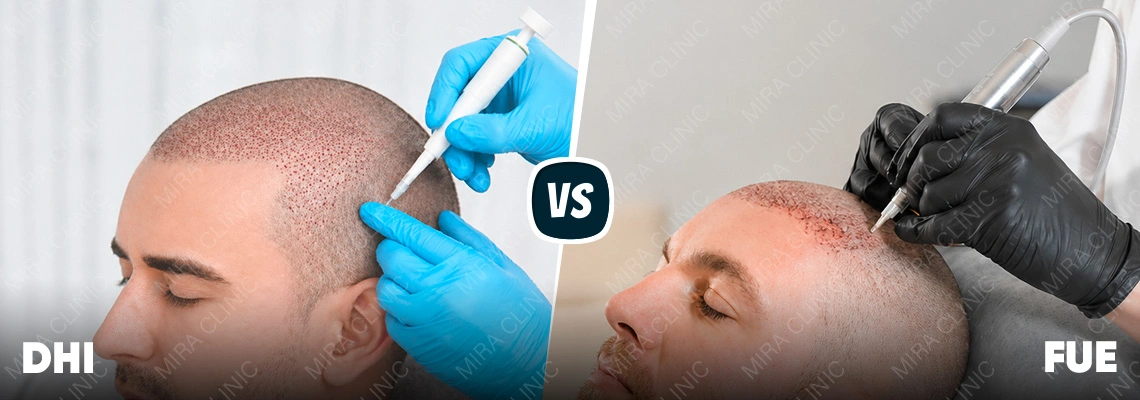
Patients do not compare DHI and FUE because they care about technique names on their own. They compare them because they want one result above all else: more visible hair density. They want a hairline that looks fuller, a frontal zone that feels thicker in real life, and a result that creates stronger visual coverage rather than simply a higher graft number on paper. That is why the real question behind DHI vs. FUE is not which method sounds more advanced, but which one creates the strongest high-density result for the right patient.
This is especially important for patients searching for a high density hair transplant in Istanbul, because density is not achieved the same way in every scalp. Some patients need very tight packing in smaller, highly visible areas such as the frontal line. Others need broader coverage across a larger zone, where the challenge is not just density concentration but intelligent graft distribution. At Mira Clinic, the decision is not based on trend language or marketing labels. It is based on scalp biology, donor capacity, the pattern of baldness, and the type of density the patient will actually notice in the mirror.
- Quick Answer: DHI Usually Offers Better Precision for Dense Placement, While FUE Usually Offers Better Large-Area Coverage
- Understanding FUE for Large-Scale Coverage
- Why DHI Is Often Preferred for High-Density Hair Transplant Work
- Direct Comparison: Placement Depth, Angle, and Proximity
- Visual Density vs Graft Density: What Patients Actually Notice
- Who Is a Better Candidate for DHI and Who Is Better for FUE
- The Hybrid Approach at Mira Clinic Turkey
- Realistic Expectations: Factors Beyond the Technique
Quick Answer: DHI Usually Offers Better Precision for Dense Placement, While FUE Usually Offers Better Large-Area Coverage
If the goal is high-density results in smaller, highly visible areas, DHI is often the stronger choice. It is especially useful when the clinic wants tighter control over placement in the hairline, temple refinement, or between existing native hairs. For patients focused on maximum compact fullness in the frontal zone, DHI often offers the clearest density advantage.
If the goal is broader restoration across a larger bald area, FUE is usually the better option for overall coverage. It often makes more sense when the patient needs density distributed across a wider front, mid-scalp, or crown region, where the challenge is not only tight packing but creating balanced fullness across a larger surface.
So the clearest medical answer is this: for high-density placement in smaller aesthetic zones, DHI is often better; for wider balding areas, FUE is often more effective overall. And in many of the strongest cases, the best density strategy is not choosing one technique blindly, but using the right technique for the right zone.
Understanding FUE for Large-Scale Coverage
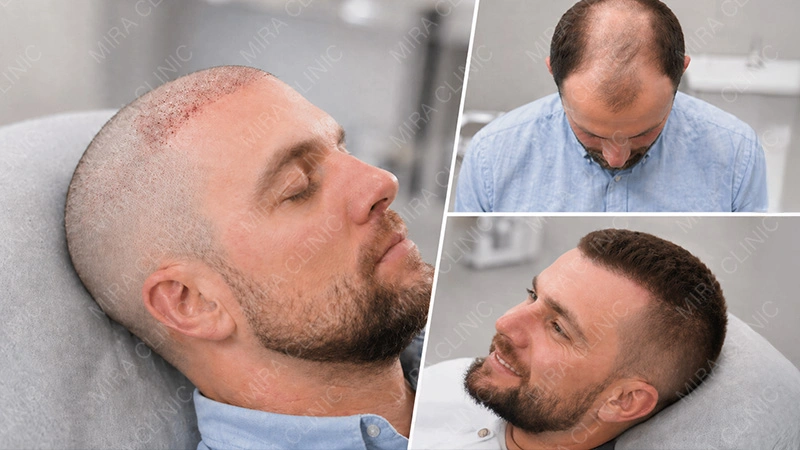
FUE, or Follicular Unit Extraction, is one of the most widely used modern hair transplant approaches because it allows the surgeon to harvest grafts individually and redistribute them across the recipient area with flexibility. It is especially useful when the patient has a wider area of baldness and needs more than just a tight frontal touch-up.
How FUE works in patients with wider areas of baldness
In broader baldness patterns, the central problem is often scale. The patient may need thousands of grafts distributed across the hairline, frontal third, mid-scalp, and sometimes crown. In these situations, FUE provides a practical and powerful way to build coverage across a wider field rather than focusing only on micro-density in a small zone.
This is why FUE often becomes the smarter choice when the patient’s main complaint is not a narrow gap but a large area of visible scalp exposure. The method allows the team to think in terms of surface restoration, which is different from ultra-compact filling.
The coverage vs density trade-off in large sessions
One of the most important concepts in hair restoration is that coverage and density are connected, but not identical. If a patient has extensive baldness, using all available grafts to create very high density in a small front area may leave the rest of the scalp too empty. FUE often helps solve this problem by making it easier to distribute grafts in a way that creates better overall balance.
This is why the best technique for hair density is not always the one that places the most grafts in the smallest square. Sometimes the better result comes from covering the visible balding pattern more intelligently so the whole scalp looks fuller, even if one small area is not packed to the maximum theoretical limit.
Why Sapphire FUE improves site creation and packing control
Modern Sapphire FUE improves traditional FUE workflows by allowing finer, cleaner recipient-site creation. This can help support closer placement, more controlled incision work, and a refined angle design compared with older recipient-site approaches. It does not magically turn every FUE case into a DHI case, but it can improve the quality of the implantation environment significantly.
That is why FUE should not be imagined as a crude or low-density option. In experienced hands, especially with sapphire blades, it can produce strong density outcomes across larger zones. But when the demand shifts from broad coverage to highly controlled dense detailing, DHI often enters the conversation more strongly.
Why DHI Is Often Preferred for High-Density Hair Transplant Work
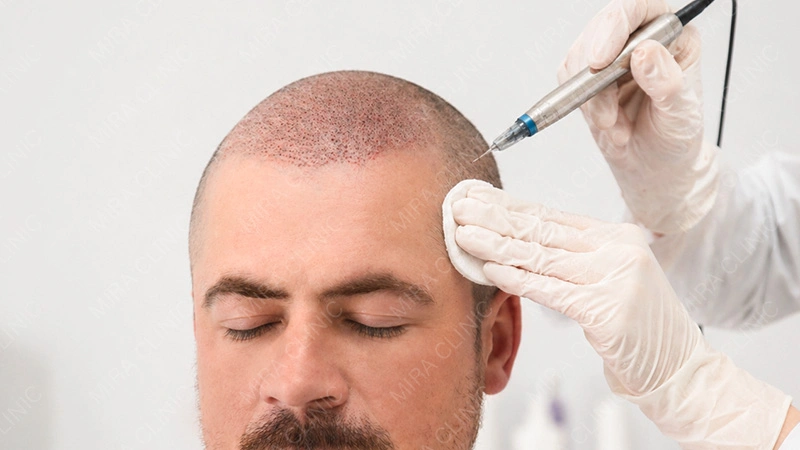
DHI, or Direct Hair Implantation, is often preferred when the goal is not simply to cover an area, but to create stronger high-density visual impact in a compact and highly visible zone. This is one of the main reasons DHI appears so often in discussions around high density hair transplant Istanbul cases, especially among patients who care most about the frontal line, close packing, and sharper cosmetic definition.
How the Choi implanter pen changes placement control
The Choi implanter pen allows the surgeon to control implantation in a way that many clinics use specifically for detailed design work. This can be especially useful in the frontal zone, where depth, direction, and angle all shape whether the final hairline looks soft, dense, and natural or artificial and flat.
In practical patient terms, this means the technique can be very strong when the clinic wants to build a sharper cosmetic effect in a limited but highly visible area.
Why DHI is often preferred for high-density hairline refinement and gap filling
When patients want high-density packing in the hairline, filling between existing hairs, or correction of visible thinning without a completely empty scalp, DHI often becomes the preferred tool. This is because the placement strategy can be more controlled in detail-heavy zones where compact visual density matters most.
That is why DHI is often described as the stronger answer for high-density refinement, especially in the front. It does not mean FUE cannot create a dense-looking result. It means DHI often gives the surgeon more control in the exact zones where patients judge density most critically.
Why DHI can be especially useful when existing hair must be protected
Patients who still have native hair in the recipient area often need careful placement between existing follicles. This is one of the zones where DHI may offer a meaningful advantage, because the surgeon can work more selectively in areas where preserving native hair matters as much as adding new density.
This makes DHI especially relevant in patients with thinning rather than full baldness, which is why the comparison cannot be reduced to “which is better overall.” It must move into how each method handles placement detail.
Direct Comparison: Placement Depth, Angle, and Proximity
Patients care about density, but dense-looking hair is not created by count alone. It is created by where the grafts are placed, how they sit under the skin, and what direction they follow when they grow.
How FUE and DHI differ in recipient-site control
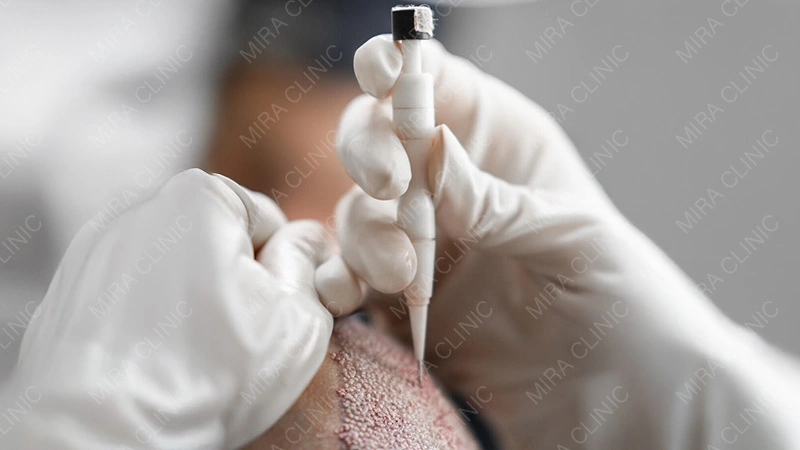
In simplified terms, FUE often separates channel creation and graft placement, while DHI integrates implantation more directly through the implanter process. That difference can influence how the surgeon manages placement detail in certain zones.
For density-focused cases, this matters because spacing is not only about how many grafts are available. It is also about how precisely they can be positioned without compromising the surrounding scalp or creating an unnatural pattern.
Why angle and direction matter as much as raw density
A hairline with poor angle design can look wrong even if it contains a large number of grafts. A frontal zone with awkward direction can look less natural even if it is numerically dense. This is why FUE vs DHI comparison should never be reduced to graft count alone.
The patient does not see “80 grafts per square centimeter” in the mirror. The patient sees softness, fullness, naturalness, and how the hair sits under light. That is why the angle of emergence matters just as much as density planning.
How graft handling and implantation workflow may influence graft management
DHI workflows are often discussed in terms of tight control over handling and placement rhythm. In selected cases, that can support more controlled graft management during implantation. But this advantage should be understood correctly: it is not an automatic guarantee of better survival in every hand or every clinic. Execution still matters.
A weak DHI case can underperform a strong FUE case if the planning or handling is poor. Technique does not replace skill. It amplifies it when used properly.
Why raw grafts-per-centimeter claims should be interpreted carefully
Patients often see fixed numbers online and assume density can be promised like a product label. That is not how good hair restoration works. Density targets vary according to donor availability, scalp flexibility, native hair presence, hair caliber, and the biological safety of close placement.
So while DHI is often better for tighter precision-density work, a trustworthy clinic should not turn that into a universal numeric promise. A good result is not created by chasing the highest number on paper. It is created by building the strongest visual outcome the scalp and donor area can support safely.
Read more: Comprehensive Guide to Hair Transplant Surgery in Turkey
Visual Density vs Graft Density: What Patients Actually Notice
This is one of the most important distinctions in hair transplantation. Patients often ask for density, but what they usually mean is visual density — how thick the result actually looks in everyday life. This is especially important in high density hair transplant Istanbul searches, because patients are rarely asking for a number alone. They are asking for a result that looks fuller, stronger, and more convincing in normal light, photos, and face-to-face interaction.
Why thicker hair shafts can look denser even with fewer grafts
Two patients can receive a similar graft count and still look completely different later. One of the biggest reasons is hair shaft caliber. Thicker hair covers more scalp visually, which means the result may look fuller even if the graft number is not extreme.
This is why best technique for hair density cannot be answered honestly without considering the biology of the donor hair itself. A patient with strong, thick donor hair may achieve excellent visible fullness without needing the same packing intensity as someone with finer hair.
How contrast between hair color and scalp affects perceived fullness
Dark hair on light scalp often shows thinning more easily than lower-contrast combinations. Likewise, curl, wave, and shaft texture all influence how much scalp shows through. This means density is partly an optical result, not only a surgical number.
A good clinical consultant explains this clearly because it helps patients understand why hair density is not identical across every scalp, even when the surgery is technically successful.
Why front hairline density and crown density should not be judged the same way
Patients often want “maximum density everywhere,” but different zones need different priorities. The frontal hairline is where density is judged most emotionally and visually. The crown usually requires a different design logic because its swirl pattern and area size make density distribution more demanding.
This is why a clinic may choose a denser-looking strategy in the front while using broader visual blending in the crown. The patient sees one result, but the surgeon is often solving two different density problems at once.
Who Is a Better Candidate for DHI and Who Is Better for FUE
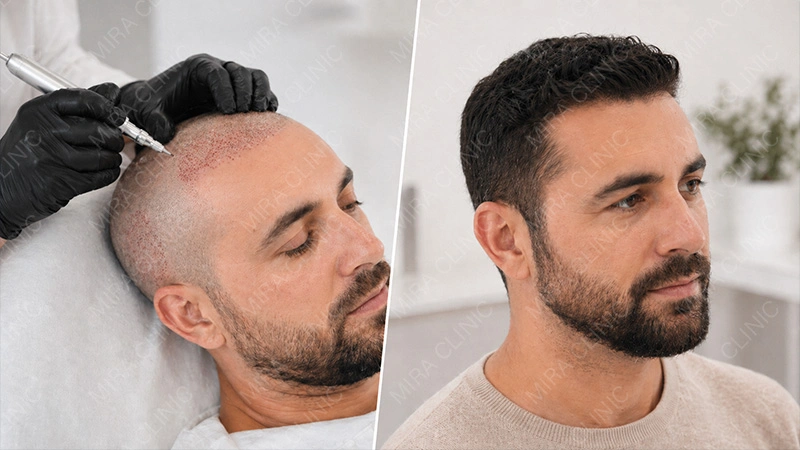
A strong density result depends partly on choosing the right patient for the right method. This is where many weaker articles lose clarity, because they talk about techniques without identifying the best candidate for each.
Best DHI candidates
DHI is often especially well suited for:
- patients who want strong frontal density
- patients needing hairline refinement
- patients with existing thinning hair that must be preserved carefully
- patients focused on dense-looking filling in smaller or medium zones
- patients prioritizing compact visual impact over very large-area coverage
This is why DHI is often the stronger answer in precision-led aesthetic planning.
Best FUE candidates
FUE is often especially well suited for:
- patients with larger bald areas
- patients needing broader frontal-to-crown coverage
- patients requiring larger graft sessions
- patients where efficient use of donor supply across a wider area is essential
- patients whose visual success depends more on strategic coverage than compact front-only packing
This is why FUE often remains the smarter solution when scale matters most.
When donor supply and recipient size make the decision easier
Sometimes the scalp makes the decision clearer than the patient’s preference does. A limited donor area combined with a large recipient zone often pushes the plan toward broader strategic distribution. A smaller target zone with a high visual demand often pushes the plan toward tighter precision work.
That is how a serious clinic thinks: not “Which technique is fashionable?” but “Which method fits this scalp, this donor, and this density goal?”
The Hybrid Approach at Mira Clinic Turkey
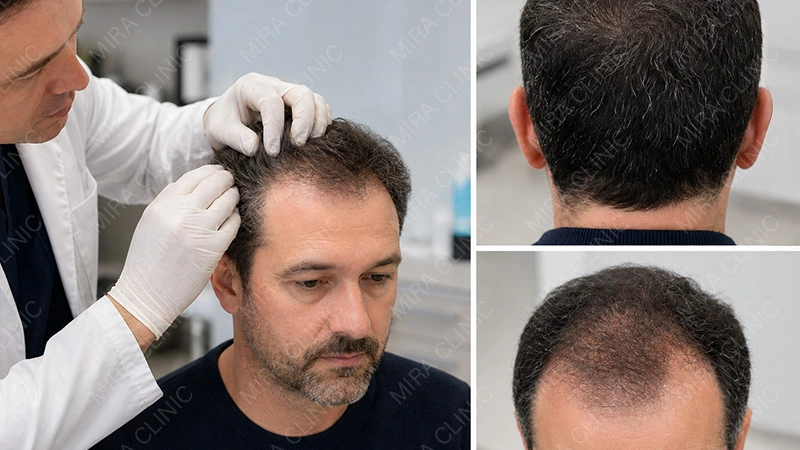
In many of the strongest density-focused cases, the best answer is not DHI alone or FUE alone. It is a hybrid approach that uses each method where it performs best. For patients seeking the strongest possible visual fullness, this often creates a better overall result than forcing one technique across every zone of the scalp.
Why combining FUE and DHI can improve overall visual density
A hybrid plan allows the clinic to think in terms of both scale and precision. The broader area can be managed with one logic, while the most visible zones can be refined with another. This often creates a more convincing final look than forcing one technique to solve every density problem equally.
How FUE may be used for scale while DHI is used for high-density refinement
At Mira Clinic, this may mean using FUE more strategically in wider areas such as the crown or broader zones of loss, while DHI is used for the hairline or dense frontal detailing where precision matters most. This is one of the smartest ways to meet high density hair transplant Istanbul expectations without pretending that every part of the scalp requires the same type of packing strategy.
Why the surgeon’s planning matters more than technique branding
This is the most important authority point in the entire article: the surgeon’s eye matters more than the marketing label. A poor plan with an expensive technique still produces a weak result. A strong plan with the right zoning can create a far better visual density outcome even if the patient originally arrived asking for only one named method.
Realistic Expectations: Factors Beyond the Technique
Technique matters, but no technique can create unlimited density from a limited donor area. This is where realistic planning protects the patient from disappointment. A strong DHI vs FUE hair transplant Turkey consultation should explain not only which method is being recommended, but also what level of density is realistically achievable from the available donor supply.
Why donor hair quality changes everything
The donor area determines the raw building material available for the result. If donor hair is thick, healthy, and stable, the clinic has more to work with visually and surgically. If donor hair is weak, limited, or fine, even the best technique must work within biological limits.
Why visual density is a mix of graft count and hair caliber
This is why two patients can receive different outcomes from similar numbers. A denser-looking result is created by the combination of:
- graft count
- hair thickness
- hair color contrast
- recipient design
- angle planning
- zone prioritization
That is the real logic behind Mira Clinic hair restoration planning.
How post-op care supports the density achieved during surgery
Even an excellent density plan still relies on proper aftercare. Healing, washing, activity restrictions, and post-operative support all contribute to how well the implanted grafts transition through recovery. Density is not only achieved in the operating room. It is protected afterward.
Why no technique can create unlimited density in one session
Patients should never be told that one session can always recreate teenage-level density everywhere. Good clinics plan for what the donor can support safely while still producing a meaningful cosmetic transformation. That is how strong hair restoration is built — not on exaggerated promises, but on realistic density strategy.
Read motre: Hair Transplant Timeline in Turkey: Month-by-Month Recovery and Growth