Rhinoplasty is no longer about giving every patient the same narrow, lifted, standardized nose. The modern goal is harmony. For many patients, especially those from Middle Eastern, Mediterranean, African, Asian, or mixed-heritage backgrounds, the best result is not a nose that looks “different enough.” It is a nose that looks more balanced while still feeling authentic to the face they were born with. Professional commentary and review literature on ethnic rhinoplasty consistently frame the procedure as preservation and refinement rather than erasing ethnic identity.
That is why ethnic rhinoplasty Turkey is no longer just a cosmetic trend. It has become a more nuanced category of facial surgery that respects anatomical variation, skin thickness, tip support, bridge shape, and airway function. At Mira Clinic Istanbul, this approach should be understood as ethnic-sensitive rhinoplasty: surgery that aims to improve proportion and definition while protecting what makes the face recognizable and natural.
- Quick Answer: The Best Nose Shape Is the One That Looks Natural on Your Face
- The Philosophy of Ethnic Rhinoplasty: Why One Size Does Not Fit All
- Understanding Facial Ratios, Skin Thickness, and Heritage
- Middle Eastern and Mediterranean Profiles: Refining the Bridge Without Losing Strength
- African and Asian Rhinoplasty: Building Definition with Support
- Function Matters Too: Why a Beautiful Nose Should Still Breathe Well
- Digital Simulation: Visualizing Your Results at Mira Clinic
- Choosing a Surgeon Who Respects Diversity
- Common Questions About Ethnic Nose Jobs
- Final Verdict: The Right Nose Shape Should Look Like You, Not Like a Trend
Quick Answer: The Best Nose Shape Is the One That Looks Natural on Your Face
The best rhinoplasty result is not the most dramatic nose, the smallest bridge, or the sharpest tip. It is the nose that fits your face, your skin, your bone structure, and your heritage. Review literature on ethnic rhinoplasty emphasizes that diagnosis should be based on individual anatomy and that the final result should blend naturally with the patient’s face rather than impose a generic aesthetic ideal.
That is why ethnic rhinoplasty is about refinement, not replacement. Different ethnic backgrounds are often associated with different structural tendencies such as thicker skin, softer lower cartilage support, wider alar base, or stronger dorsal profile, but these are planning patterns, not stereotypes. The surgeon’s job is to understand those variables and refine the nose without making it look disconnected from the rest of the face.
Natural results depend less on following trends and more on respecting ratios. A nose can be technically changed and still look wrong if it does not belong to the face around it. That is why natural rhinoplasty results Turkey should always be judged by harmony, not by how obviously “done” the nose appears.
The Philosophy of Ethnic Rhinoplasty: Why One Size Does Not Fit All
A generic rhinoplasty model often fails because it assumes every attractive nose should move toward the same narrow template. That approach can create results that look disconnected from the cheeks, chin, lips, forehead, and overall facial identity. ASPS commentary on ethnic rhinoplasty explicitly highlights the importance of preserving physical features tied to ethnic identity rather than removing them.
Why the “standard Western nose” approach often fails
For patients with naturally thicker skin, broader nasal bones, softer tip cartilage, or a stronger dorsal profile, pushing too hard toward a generic narrow or over-rotated nose can create imbalance. The result may look artificial not because the surgery was aggressive in a technical sense, but because it ignored the architecture of the face. Review literature on ethnic rhinoplasty repeatedly supports individualized structural planning over one-template reshaping.
Loss of identity
One of the biggest patient fears is looking like a different person. That concern is legitimate, and modern ethnic rhinoplasty exists largely to avoid that outcome.
Mismatch with facial proportions
Even a technically “pretty” nose can look wrong if it does not fit the patient’s lips, brow, chin, and midface structure. Rhinoplasty is widely described by major clinical sources as a procedure that should improve facial harmony and proportion, not just nose size in isolation.
Why refinement matters more than transformation
Refinement means preserving recognizability while improving definition, balance, and proportion. That is a very different goal from complete transformation, and it is one reason ethnic rhinoplasty tends to rely more on structural support and controlled shaping rather than aggressive tissue removal.
Preserving recognizable facial character
The ideal result is often subtle enough that people notice improvement without being able to identify a “surgical” look immediately.
Improving balance without overcorrection
Overcorrection is one of the main ways rhinoplasty loses naturalness. A stronger article positioning for Mira Clinic should emphasize balance and proportion rather than dramatic change. This is consistent with review-based approaches to ethnic rhinoplasty.
Why Mira Clinic focuses on facial harmony over fashion
Trend-based nose shapes age badly because trends shift faster than faces do. A structurally sound, proportionate, identity-preserving nose remains believable much longer. That is the stronger authority position for a clinic.
Natural fit
The most successful result is one that appears to belong to the patient’s face.
Long-term aesthetic credibility
Patients usually remain happier with results that look timeless rather than trend-driven. This follows the broader philosophy reflected in professional rhinoplasty guidance focused on form and function rather than fashion.
Understanding Facial Ratios, Skin Thickness, and Heritage
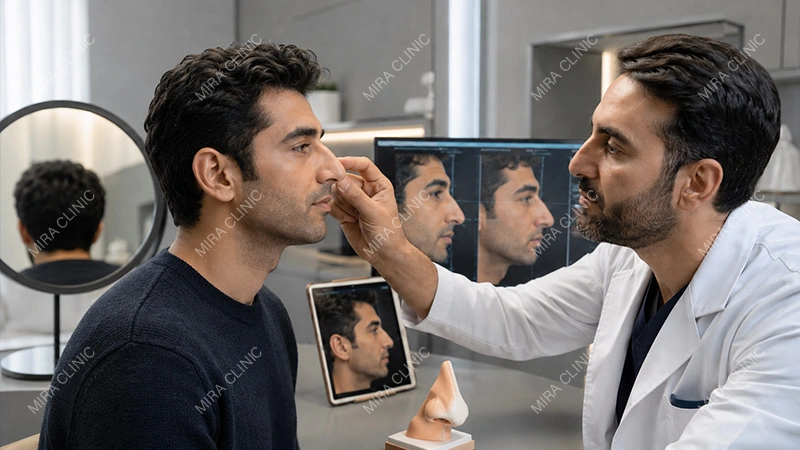
Ethnic rhinoplasty begins with anatomy. Different patients bring different combinations of skin thickness, cartilage strength, nostril width, bridge height, and overall facial ratio. The same maneuvers will not produce equally natural results on every face. Review literature emphasizes that ethnic rhinoplasty planning should be based on anatomical findings and patient-defined goals, not on assumptions about what is “beautiful” in one universal way.
Why ethnicity influences nasal anatomy
This is not about putting patients into rigid categories. It is about recognizing recurring structural patterns that affect how surgery is planned. Review articles on African-descendant and Latino rhinoplasty, for example, discuss common themes such as thick skin, weaker projection, and the need for structural grafting and support in many cases.
Bridge
Some patients want bridge reduction, while others need bridge augmentation or more definition. The right answer depends on anatomy, not trend.
Tip support
Tip support is especially important in many ethnic rhinoplasty cases because refinement without adequate support can collapse into an artificial or unstable result.
Nostril width
Alar base width matters aesthetically and structurally, but narrowing must be balanced carefully to avoid an unnatural look. African-descendant rhinoplasty literature explicitly discusses alar base reduction as one element within a larger structural plan, not as an isolated goal.
Skin envelope
Skin thickness strongly influences what can be seen externally after structural changes underneath.
Why thick skin changes surgical planning
Thick skin is one of the most important technical variables in ethnic rhinoplasty. It can make tip definition more challenging because the skin-soft tissue envelope may obscure fine changes underneath. Recent literature in thick-skin rhinoplasty supports structural tip-support strategies and grafting to improve projection and definition in these patients.
Tip definition challenges
A nose with thick skin cannot be planned the same way as a thin-skinned nose because the visible response to underlying changes will differ.
Support strategies
Structural grafting and support techniques are often central in these cases because support is what creates durable definition.
Why patience matters in recovery
Patients with thicker skin may need more patience before final definition becomes visible, because swelling and skin behavior can make refinement slower to reveal itself. This is consistent with the structural thick-skin discussion in the literature.
Why the perfect nose is the one that belongs to your face
The “perfect” nose is not a fixed shape. It is the one that makes the face look more harmonious without making the patient look ethnically or personally unfamiliar.
Natural proportions
Rhinoplasty should improve nasal proportion in relation to the face, not create a disconnected feature.
Identity preservation
That is the central principle of ethnic rhinoplasty and the most important long-term trust signal for patients.
Middle Eastern and Mediterranean Profiles: Refining the Bridge Without Losing Strength
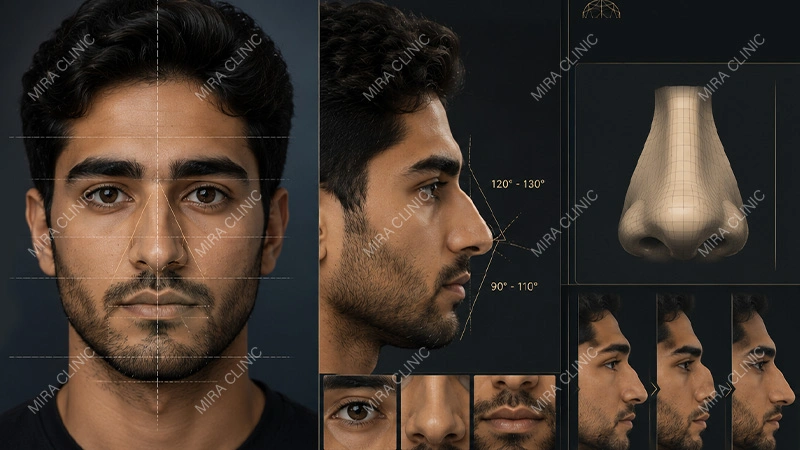
In Middle Eastern and Mediterranean patients, one of the most common goals is reducing a dorsal hump while keeping the profile strong and dignified rather than over-softened. That requires restraint and proportion, not aggressive flattening.
Why dorsal hump reduction must stay proportional
A dorsal hump can be reduced successfully, but if the bridge is over-lowered, the profile can lose strength and begin to look disconnected from the rest of the face. Professional rhinoplasty sources consistently frame the goal as improved harmony and proportion, not maximal reduction.
Strong profile vs over-reduction
A refined profile can still be a strong profile. That distinction is often what separates a natural result from an over-operated one.
Maintaining dignity and structure
This is especially important in faces where a stronger profile contributes to identity and facial balance.
Why the nasolabial angle matters
The angle between the nose and upper lip strongly affects expression. Over-rotation can make the nose look too elevated or too “done,” particularly in faces where a more grounded, balanced tip position looks more natural.
How rotation changes expression
Subtle changes in tip rotation can make a face look softer, more open, more lifted, or less natural depending on proportion.
Avoiding an over-operated look
A refined result is usually more successful than a hyper-rotated one when the patient wants identity-preserving surgery.
How surgeons create a refined but familiar result
The best approach usually combines hump smoothing, careful tip control, and proportionate profile planning rather than dramatic reshaping.
Bridge smoothing
The goal is often continuity and elegance, not total flattening.
Tip balance
Tip shape must align with the new bridge, not compete with it.
Profile harmony
The final profile should still look like the patient, just more refined.
African and Asian Rhinoplasty: Building Definition with Support
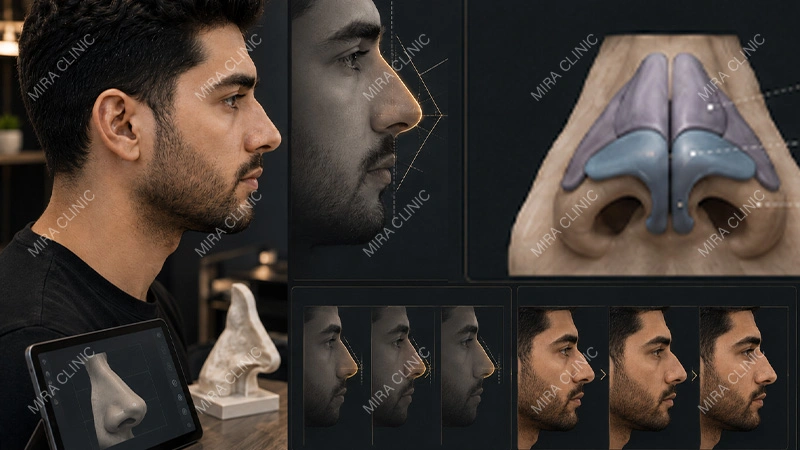
In many African and Asian rhinoplasty cases, the challenge is less about removing projection and more about creating support, definition, and proportion in a way that remains natural. Review literature on African-descendant rhinoplasty highlights tip definition, dorsum augmentation, and alar base management as key themes, often supported by grafts and structural planning.
Why tip definition often requires structural support
Definition often depends on support beneath the skin, especially when the skin envelope is thicker or the underlying framework is less projecting.
Projection
Tip refinement often means increasing structural clarity, not simply reducing size.
Cartilage grafting
Cartilage grafts are commonly used where support is needed, including in structural rhinoplasty approaches documented by major centers and the literature.
Soft tissue considerations
Skin thickness and soft tissue behavior change how visible the refinement will be externally.
Why nostril narrowing and bridge definition must stay balanced
Too much narrowing or an overbuilt bridge can look artificial just as easily as undercorrection can look incomplete. The nose still needs to belong to the face.
Facial fit
Every structural change should be judged against the whole face, not in isolation.
Avoiding overcorrection
The most natural result usually comes from controlled definition rather than aggressive change.
How heritage can be preserved while shape is refined
This is the central goal of ethnic rhinoplasty.
Definition without identity loss
A more defined nose does not need to become ethnically anonymous.
Support without artificiality
Structural support is a tool for naturalness when used well, not a reason for the nose to look stiff or obviously surgical.
Read more: Comprehensive Guide to Facial Plastic Surgery in Turkey 2025: Techniques, Costs, and Top Surgeons
Function Matters Too: Why a Beautiful Nose Should Still Breathe Well
Rhinoplasty should never be discussed as if it is purely cosmetic. AAO-HNS emphasize that rhinoplasty can affect nasal structure and breathing, and professional guidance specifically addresses both form and function after rhinoplasty.
Why rhinoplasty is not only cosmetic
Patients often seek rhinoplasty for appearance, but many also have breathing concerns or structural issues that need consideration.
Breathing concerns
Nasal airway function matters both before and after surgery.
Structural considerations
The internal support of the nose affects how well it breathes and how stable the shape remains.
Why support and airway planning matter in ethnic rhinoplasty
A structurally weak result may not only look less natural. It may also perform poorly functionally.
Septum
Septal structure is often relevant to both support and breathing.
Tip support
Tip support matters aesthetically and functionally.
Internal balance
Good rhinoplasty balances outer shape with inner function.
What patients should ask about breathing before surgery
Patients should ask explicitly whether breathing has been evaluated as part of the surgical plan.
Baseline breathing
How well do you breathe now?
Functional planning
Will the surgeon address structure as well as shape?
Combined goals
Can the procedure improve both aesthetics and breathing if needed?
Read more: Rhinoplasty in Turkey 2026: Top Surgeons, Real Costs & What to Expect
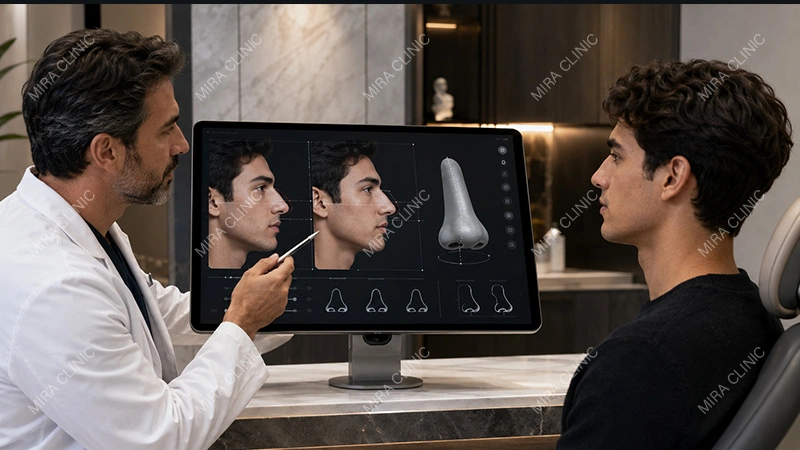
Digital Simulation: Visualizing Your Results at Mira Clinic
Digital imaging can be very useful in rhinoplasty consultations, but it should be framed as a communication tool, not a promise machine.
How 3D imaging helps patients understand realistic options
ASPS offers 3D educational tools broadly for plastic surgery, reflecting the role visual simulation can play in patient understanding. More importantly, rhinoplasty planning benefits when patients can see how subtle changes affect facial harmony before surgery.
Education, not fantasy
A good simulation should educate the patient about proportion and options, not sell an unrealistic ideal.
Facial fit
It helps show whether a proposed bridge, tip, or profile change still fits the face.
Why simulation is especially useful in ethnic-sensitive planning
In ethnic rhinoplasty, small proportional changes matter. Simulation can help the patient and surgeon discuss those changes more precisely.
Comparing subtle changes
Small changes in projection, hump reduction, or tip rotation can produce very different expressions.
Protecting identity
Simulation can help keep the planning anchored in recognizability.
Why choosing the final shape should be collaborative
The best result usually comes from discussion, not one-sided decision-making.
Patient goals
The patient should be able to describe what feels too strong, too wide, too projected, or too undefined.
Surgeon judgment
The surgeon should translate those goals into something structurally realistic.
Shared planning
That collaboration is one of the best ways to avoid a result that feels technically good but personally wrong.
Choosing a Surgeon Who Respects Diversity
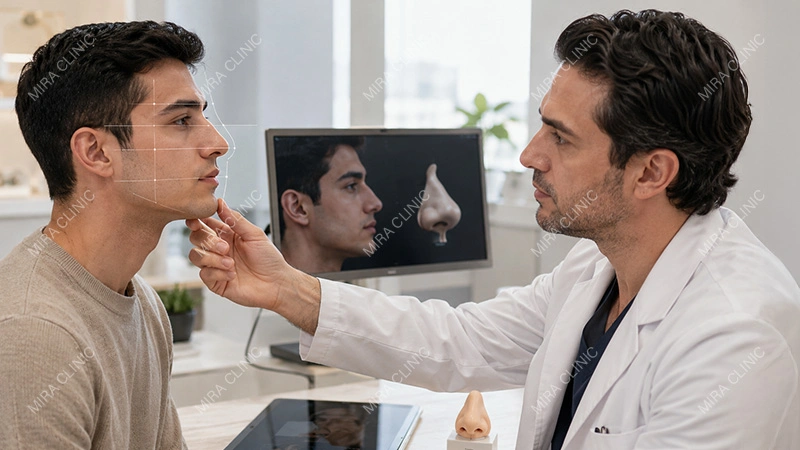
Surgeon choice matters more in ethnic rhinoplasty because the procedure demands both structural control and cultural sensitivity.
Why international experience matters
A surgeon who works with diverse patients is more likely to understand the variation in anatomy, expectations, and aesthetic priorities across different faces.
Different facial anatomies
Different backgrounds may present different structural patterns, skin behavior, and design challenges.
Different expectations
Some patients want hump reduction but no loss of strength. Others want more definition without identity loss. That nuance matters.
What to look for in before-and-after galleries
Patients should not look only for dramatic transformations. They should look for believable, natural outcomes in people with similar features.
Patients with similar heritage
This helps the patient judge whether the surgeon understands relevant anatomy and aesthetic goals.
Natural rather than generic outcomes
The best gallery is one where patients still look like themselves.
Why structural expertise matters more than trend-based marketing
A surgeon who talks only about shape may not be enough. A surgeon should also be able to discuss support, airway, cartilage, thick skin, and realistic limits.
Support
Strong support often underlies natural-looking outcomes.
Balance
The nose must fit the face, not a trend board.
Breathing
Function should remain part of the conversation.
Common Questions About Ethnic Nose Jobs
Will an ethnic rhinoplasty affect my breathing
It should be planned with breathing in mind, not against it. Rhinoplasty can improve form and may also address structural breathing concerns when properly evaluated.
Is recovery longer for thick-skinned patients
Thick-skinned patients may need more patience for tip definition to show clearly because the skin-soft tissue envelope can mask early refinement.
How do I make sure my nose still looks like me after surgery
Choose a surgeon who discusses harmony, heritage, support, and realistic facial fit rather than offering a standard template.
Do cartilage grafts make the result look less natural
Not when used well. In many ethnic rhinoplasty cases, grafts are part of what makes the result look more natural and more structurally believable.
Can digital simulation guarantee the final result
No. It is a planning and communication tool, not a guarantee. But it can still be extremely useful for choosing a direction that fits the face.
Final Verdict: The Right Nose Shape Should Look Like You, Not Like a Trend
The strongest ethnic rhinoplasty result is not the one that looks most dramatically changed. It is the one that looks most convincingly right on the patient’s face. Professional commentary and review literature support the same principle: preserve identity, improve harmony, and build support where needed rather than replacing one facial language with another.
That is why harmony matters more than imitation. A nose that still looks like it belongs to you will almost always age better, feel more authentic, and generate more lasting satisfaction than a trend-driven result. And that is the real authority position for Mira Clinic rhinoplasty expertise: not selling one “ideal” nose, but helping each patient find the shape that fits their face and heritage naturally.