- The Psychological Barrier of Hair Loss and Shaving
- Why Turkey Is the Leading Destination for Female Hair Restoration
- The Science of Discretion: How U-FUE Works Without Shaving
- Aesthetic Advantages of the No-Shave Approach for Your Trip
- Specialized Female Hairline Design at Mira Clinic Istanbul
- What to Expect During Your Medical Journey to Mira Clinic
- Recovery and Maintenance of Long Hair After Surgery
- Final Verdict: A Journey That Protects Privacy and Restores Confidence
The Psychological Barrier of Hair Loss and Shaving
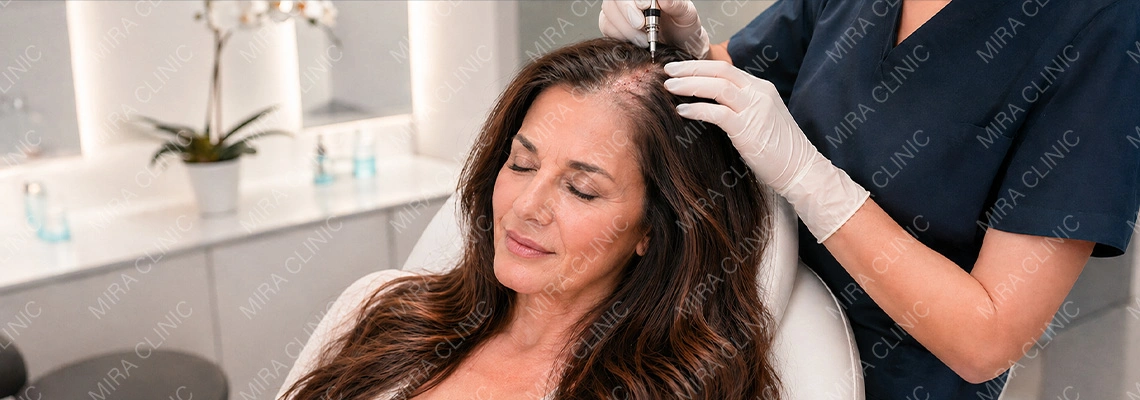
For many women, hair loss is not experienced as a simple cosmetic inconvenience. It affects identity, privacy, confidence, and daily life. Thinning around the part line, reduced density at the temples, or visible scalp through long hair can feel deeply personal, which is one reason many women delay treatment for years. Female hair restoration literature reflects this difference: women often seek treatment not only to restore density, but to regain normalcy and confidence without drawing attention to the procedure itself.
One of the biggest barriers is not surgery itself, but the fear of shaving. Many patients can accept a medical procedure more easily than they can accept the idea of losing their existing hairstyle during recovery. That is why the unshaven hair transplant for women in Turkey has become such an important option. It gives privacy-conscious patients a bridge between medical necessity and aesthetic discretion. Rather than forcing women into a visibly “post-surgical” look, the no-shave approach allows many to preserve their appearance while addressing real density loss.
At Mira Clinic Istanbul, this is not framed as a basic procedure. It is treated as a carefully planned transformation journey: a woman flies into Istanbul seeking density, reassurance, and privacy, and returns home with renewed confidence and minimal visible disruption to her social life.
Why Turkey Is the Leading Destination for Female Hair Restoration
Why international female patients choose Istanbul
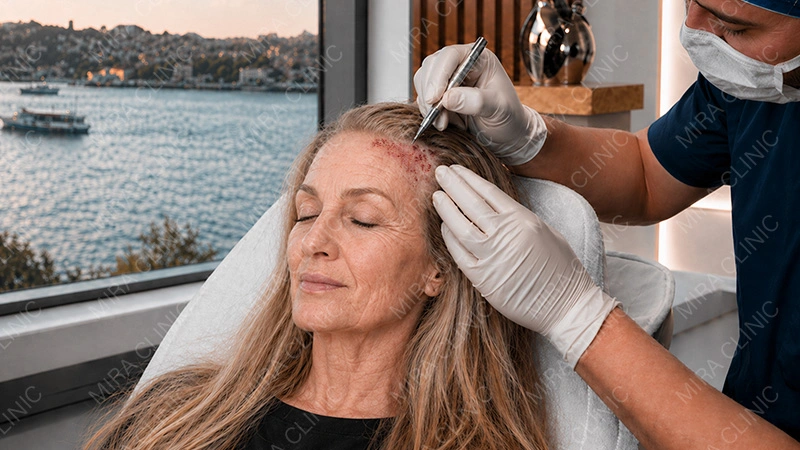
Turkey has become a major destination for hair restoration because it combines high procedure volume, experienced teams, and a strong medical-tourism infrastructure. For women, however, the attraction goes beyond general popularity. Female patients often search specifically for clinics that understand long hair management, temple design, discreet recovery, and the social concerns attached to visible signs of surgery. Current destination guides focused on women’s hair restoration in Istanbul note that unshaven FUE and long-hair approaches are among the main reasons female patients choose Turkey over many local alternatives.
Advanced medicine combined with hospitality
The appeal of Istanbul is not only surgical. It is also logistical. For international patients, especially women traveling for a highly personal aesthetic procedure, coordinated transportation, accommodation support, clear scheduling, and structured post-operative follow-up can reduce stress significantly. Good medical tourism is not just about what happens in the operating room; it is about whether the entire journey feels safe, manageable, and private.
Why Mira Clinic is positioned for female hair restoration
Mira Clinic positions female hair restoration as a privacy-first, design-led treatment rather than a generic transplant session. That distinction matters because women often arrive with very different goals from male patients. They may want to restore the part line, soften temple recession, preserve styling options, and avoid the social exposure that comes with a shaved scalp.
Why this matters more than standard hair transplant marketing suggests
A clinic can advertise graft numbers and package deals, but that does not answer the question most women actually ask:
“Can I do this without sacrificing my appearance during recovery?”
That is why the unshaven technique has become such a powerful consultation point in premium female hair restoration.
The Science of Discretion: How U-FUE Works Without Shaving
What is an unshaven hair transplant?
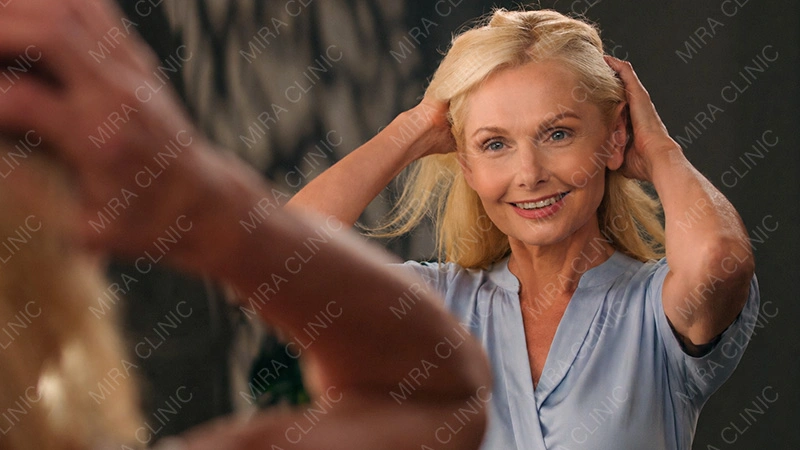
An unshaven hair transplant is a form of FUE in which the patient does not undergo a full visible shave of the scalp. In practice, this usually means preserving the appearance of long hair while the surgeon works through selective access points rather than removing all visible length. Current guidance distinguishes between unshaven FUE and long-hair FUE, noting that both are designed for patients who want to avoid the obvious shaved look, though they differ technically in how the grafts are handled.
How follicles are extracted without shaving the recipient area
In the unshaven approach, the surgeon works between existing long hairs and may use limited selective trimming in donor access zones when necessary. Because the field is visually tighter and the hair remains in place, the extraction phase requires more time, more planning, and more surgical precision than a standard shaved FUE workflow. Reviews of long-hair and advanced FUE techniques describe this approach as technically demanding but especially attractive for patients who prioritize privacy and immediate visual camouflage.
Implanting between long hairs without damaging surrounding follicles
The recipient phase is where discretion and precision meet. The surgeon must place grafts between existing hairs while preserving the surrounding follicles and maintaining natural direction. Recipient-area planning is widely recognized as one of the most critical aspects of successful hair transplantation because natural appearance depends not just on graft survival, but on angle, distribution, density transition, and placement artistry.
Why this technique requires more precision than standard FUE
Because visibility is more limited and the existing hairstyle remains in place, there is less room for mechanical error. That is also why the unshaven technique is usually more selective in candidacy and often more expensive than standard FUE.
Aesthetic Advantages of the No-Shave Approach for Your Trip
Instant camouflage during your stay in Istanbul
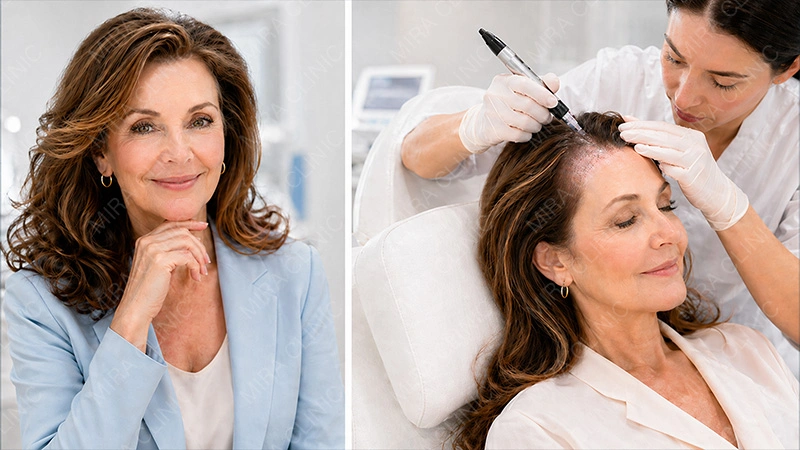
One of the main advantages of the no-shave technique is what many patients call instant camouflage. Existing hair can help conceal treated areas during the first phase of healing, which means the procedure is often less visually obvious than fully shaved techniques. This does not mean the procedure is literally invisible from day one, but it does mean that the patient can often move through public spaces with more comfort and discretion.
Maintaining your current hairstyle throughout the journey
For women with long hair, keeping their existing hairstyle is not a minor preference. It is often central to their willingness to proceed at all. Maintaining visible length can reduce emotional stress during the medical trip, support self-image in the mirror, and make the entire process feel like a continuation of one’s identity rather than a disruptive transformation.
Returning to social and professional life with more confidence
Because visible shaving is avoided, many women find that the transition back into work, family, or social life feels easier. This matters especially for patients who do not want to explain a dramatic appearance change to colleagues, relatives, or friends. Privacy, in this sense, becomes part of the treatment value.
Why discretion is one of the biggest decision factors for women
In many consultations, the real question is not “Can I have a transplant?”
It is “Can I have one without everyone knowing?”
The no-shave method addresses that concern directly.
Specialized Female Hairline Design at Mira Clinic Istanbul
Why female hairline design is different
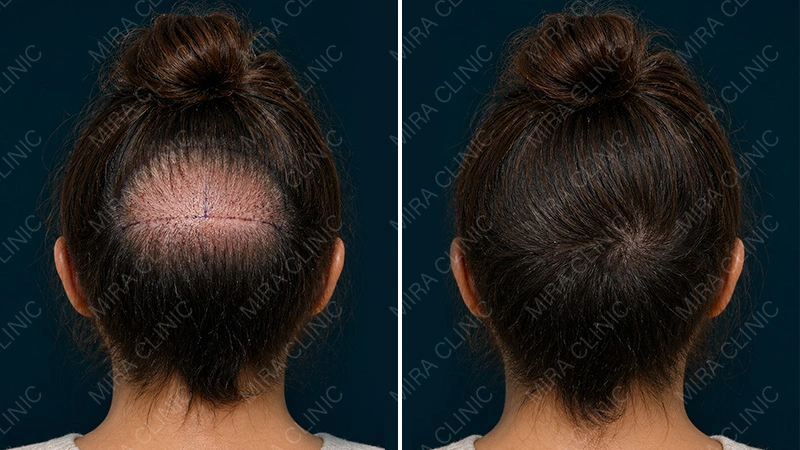
A female hairline should not be planned like a male one. Women typically need softer contours, more delicate transitions, and a shape that works with facial framing, temple balance, and the natural part line. Research on female hairline design shows that individualized planning is essential because beauty in this area depends on proportion, softness, and natural asymmetry rather than rigid geometric lines.
The importance of temple and parting line density
For many women, the most important change is not a dramatic frontal line, but better density in the temples or along the part. These are the zones that can make the face look more youthful, healthy, and naturally framed. Female-focused restoration therefore often prioritizes subtle density distribution rather than simply pushing the hairline forward.
Sapphire technology and micro-incision precision
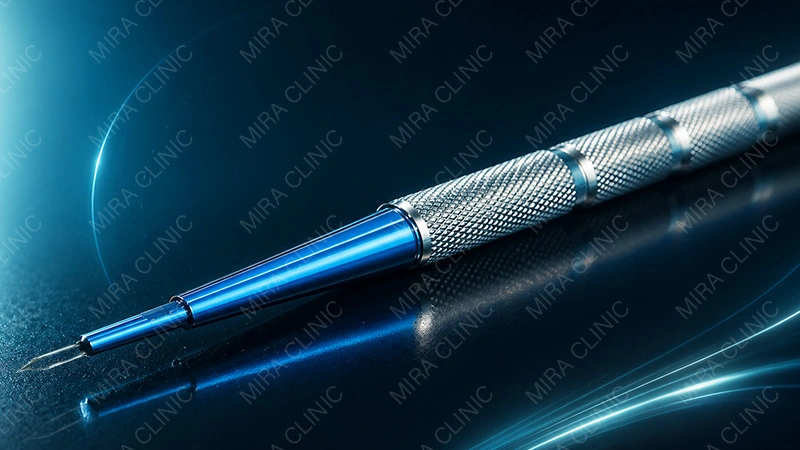
At Mira Clinic, Sapphire-based recipient site creation is used to support highly controlled implantation. Sapphire tools are often chosen because they allow precise, fine incisions that can support careful placement when performed correctly. The benefit is not “invisible healing” as a guarantee, but a more refined surgical approach that can minimize visible disruption when paired with good aftercare.
Why natural design matters more than graft count
Patients often ask about numbers first. But for a natural female result, design matters at least as much as count. Hairline softness, part-line density, angle of growth, and temple framing are what separate a merely “filled” result from a genuinely elegant one.
What to Expect During Your Medical Journey to Mira Clinic
Before you fly: the private consultation process
The journey usually begins with remote consultation, photo review, and discussion of whether the patient is suitable for an unshaven procedure. Not every woman is a candidate for this method, so careful initial screening matters.
Arrival in Istanbul and clinical preparation
Once in Istanbul, the patient’s schedule is structured around evaluation, planning, and the treatment day itself. The goal is to make the process feel private and clear rather than rushed. Good clinical preparation reduces anxiety because the patient understands both the aesthetic plan and the practical details of recovery.
The treatment-day experience
An unshaven hair transplant should feel more like a focused aesthetic procedure than a blunt, high-volume package treatment. The clinical environment, staff communication, and pacing of the day all influence how reassured the patient feels.
The all-inclusive journey for international female patients
For women traveling abroad, the quality of the journey often matters almost as much as the surgery itself. Airport coordination, accommodation guidance, treatment-day structure, and responsive aftercare can turn a stressful international procedure into a manageable and even empowering experience.
Why a structured journey reduces stress before surgery
The more organized the experience is, the less mental energy the patient has to spend on logistics and uncertainty. That leaves more emotional room for trust.
Read more: DHI vs FUE for Hair Density: Which Technique Gives Thicker Results in Turkey
Recovery and Maintenance of Long Hair After Surgery
The first 48 hours: protecting the survival window
The first 48 hours are the most sensitive period for newly implanted grafts. Standard hair transplant guidance emphasizes protecting the scalp from pressure, friction, and unnecessary touching during this phase. This is especially important when traveling, sleeping in a hotel, or flying home soon after the procedure.
Washing and managing long hair after the procedure
Long hair requires gentle washing, patient handling, and a clear post-op routine. The recipient and donor areas must be cleaned without dragging, scratching, or pulling. This is one of the reasons post-operative instructions for unshaven female patients need to be especially personalized.
Protecting grafts during the flight home
The journey home is part of the treatment, not something separate from it. Posture, head support, and avoiding accidental rubbing against seats, windows, or hands are all important. Patients need to understand how to protect the grafts during travel, not just during the first night.
Long-term support for final density
Post-operative care does not stop after the first wash. Many clinics, including Mira Clinic, support long-term recovery with follow-up guidance, post-op kits, and scalp-care recommendations designed to improve comfort and support the final density phase.
When can women return to styling routines?
The timeline for dye, heat styling, and tighter hairstyles depends on healing progress. These steps should be resumed only when the clinic confirms that the scalp is ready.
Read more: Hair Transplant Timeline in Turkey: Month-by-Month Recovery and Growth
Final Verdict: A Journey That Protects Privacy and Restores Confidence
The unshaven hair transplant for women in Turkey is not just a softer version of standard FUE. It is a privacy-focused, aesthetic-first solution for women who want real density restoration without surrendering their current hairstyle. For the right patient, it offers something deeply valuable: the ability to travel to Istanbul for treatment, move through recovery with greater discretion, and return home with renewed confidence rather than obvious signs of surgery.
At Mira Clinic Istanbul, that journey is designed around precision, natural female aesthetics, and the practical realities of international medical travel. The goal is not only to restore hair. It is to restore control over how you look, how you feel, and how confidently you return to your life.
Read more: Why Do Hair Transplants Fail? 5 Critical Mistakes to Avoid Before Flying to Turkey