Most patients compare hair transplant techniques by graft count, price, or clinic reputation. But one of the most important differences often sits at a much smaller level: the way the recipient sites are created in the scalp. In FUE-based hair restoration, recipient-site creation influences healing, redness, scab pattern, hairline refinement, and how naturally the grafts can be placed. The International Society of Hair Restoration Surgery notes that hair characteristics, recipient planning, and site creation all affect the appearance of density and the final cosmetic result.
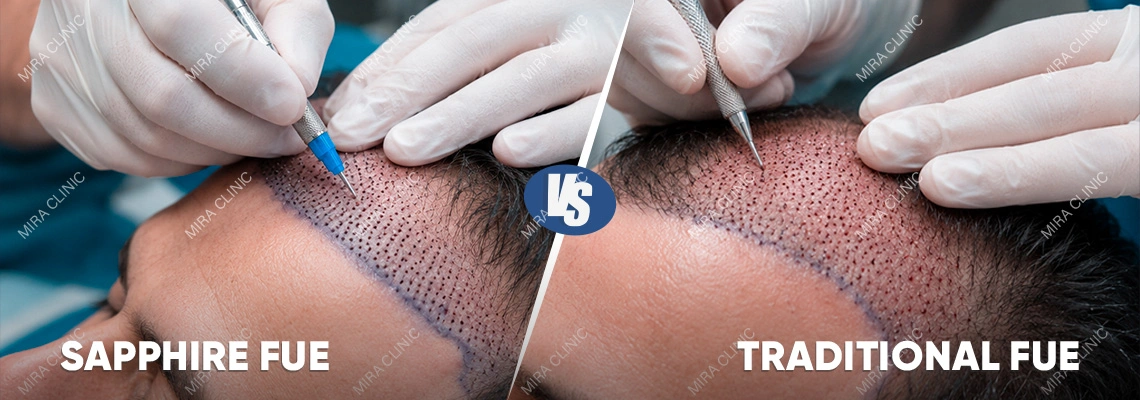
That is why the comparison between sapphire and traditional steel-blade FUE matters. Sapphire FUE is not a completely different transplant family from FUE. It is better understood as a refinement within FUE, where sapphire-tipped blades are used for recipient-site creation instead of conventional steel blades. The technical promise is greater incision precision, cleaner channel formation, and potentially smoother early healing when the method is used well. But the blade alone does not create a successful transplant. Surgical planning, donor management, hairline design, and aftercare still matter more than marketing language.
- Quick Answer: Sapphire FUE Usually Improves Incision Precision and Healing Control
- What Is Traditional FUE and How Does It Work
- What Makes Sapphire FUE Different
- Why Blade Material Matters for Healing
- Sapphire FUE vs. Traditional FUE: What Patients Actually Notice
- Does Sapphire FUE Improve Density or Just Healing
- Who Is the Better Candidate for Sapphire FUE
- Sapphire FUE at Mira Clinic: Why Technique Must Match the Scalp
- What Affects Healing Beyond the Blade
- Comparison Table: Sapphire FUE vs. Traditional FUE
- Comparison Table: What Patients Care About Most
- Realistic Expectations: Is Sapphire FUE Always Better
- Final Verdict: Why Precision at the Incision Level Still Matters
Quick Answer: Sapphire FUE Usually Improves Incision Precision and Healing Control
Sapphire FUE usually offers finer recipient-site control than traditional steel-blade FUE, which may support smoother-looking healing, more precise channel creation, and more refined placement in the right hands. Evidence and expert commentary suggest sapphire blades can reduce tissue injury in recipient-site creation compared with some other blade shapes, and clinics often position sapphire as especially useful when aesthetic precision matters.
For patients, the most visible differences are usually not dramatic “magic” changes. They are subtler and more practical: cleaner early healing, better control in dense or delicate zones, and potentially more refined work in the hairline. Traditional FUE remains effective and widely used, but sapphire FUE is often preferred by clinics that prioritize micro-precision in channel creation and patient-facing recovery appearance.
The clearest way to understand the difference is this: sapphire may improve the quality of the incision environment, but the overall result still depends on the surgeon’s judgment. A strong surgeon using a conventional steel setup can still outperform a weak sapphire case. The blade is important, but it is a precision tool inside a larger surgical system.
What Is Traditional FUE and How Does It Work
Traditional FUE, or Follicular Unit Extraction, is a hair transplant method in which follicular units are harvested individually from the donor area and then implanted into the recipient area. The ISHRS FUE guidelines describe FUE as a technique built around individual follicular extraction and careful planning of both donor and recipient areas.
How traditional FUE extracts and implants grafts
In the donor area, follicular units are extracted one by one rather than as a strip. In the recipient area, sites are created to receive those grafts in a pattern that should match the intended hairline, density, and direction. This basic framework remains the foundation of many modern hair transplant techniques.
What happens in the donor area
The donor zone is assessed for density, caliber, hair direction, and long-term safety. These factors affect how many grafts can be safely harvested and how strong the final result may look. The ISHRS specifically emphasizes evaluating hair direction, color, angle, caliber, and curl because they affect the appearance of density.
What happens in the recipient area
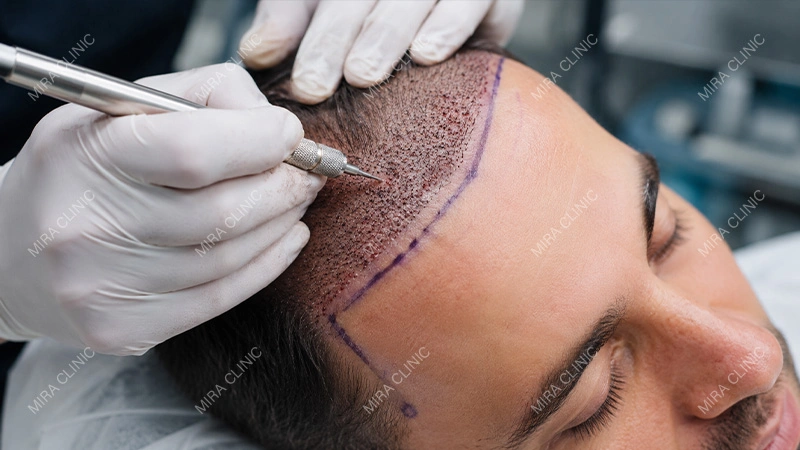
Once grafts are harvested, recipient sites are created to control angle, direction, spacing, and distribution. This is one of the most important parts of the whole surgery because recipient-site creation largely determines whether the final result appears natural or artificial.
Why traditional steel blades were widely used for years
Steel blades became standard because they were practical, familiar, and effective within established FUE workflows. Traditional FUE remains a valid and widely practiced method, and many surgeons still use conventional steel systems successfully depending on scalp type, case design, and personal technique preference.
Strength, familiarity, and standardization
One reason steel remained dominant for years is that it fit established surgical routines and training patterns. It offered predictability within standard FUE workflows, especially before sapphire variants became widely marketed.
Where traditional FUE still remains effective
Traditional FUE can still perform well in experienced hands, especially in broader standard cases where overall planning and donor management matter more than premium branding. It is not obsolete. The real question is whether a different blade material can improve the recipient-site phase enough to justify its use in modern precision-focused clinics.
What patients usually experience with standard FUE healing
Healing after standard FUE generally includes redness, scabbing, early sensitivity, and a visible post-op period that improves over days to weeks. Exact recovery differs by patient biology, scalp sensitivity, aftercare, and surgical handling.
Healing timeline
Most patients move through an early recovery phase involving crusting and redness before the scalp gradually normalizes. The details vary, but the principle is consistent: recipient-site quality influences how this early period looks and feels.
Redness, scabbing, and early recovery expectations
The visible recovery period is often one of the biggest patient concerns because it affects confidence and return to normal life. That is one reason sapphire FUE gained attention in Turkey and elsewhere: it is often marketed around the promise of more refined healing conditions.
Read more: DHI vs FUE for Hair Density: Which Technique Gives Thicker Results in Turkey
What Makes Sapphire FUE Different
Sapphire FUE is not a separate transplant family from FUE. It is an FUE workflow in which sapphire blades are used to create recipient sites. Multiple expert sources describe sapphire FUE this way rather than treating it as an entirely separate extraction technique.
What sapphire blades are and how they differ from steel
Sapphire blades are designed to create recipient channels with a different material and geometry than standard steel blades. The claimed advantage is cleaner, sharper, and more controlled recipient-site creation. Expert commentary and comparative guides consistently frame sapphire as a precision upgrade in channel creation rather than a replacement for surgical judgment.
Blade material and sharper edge control
The argument for sapphire is that it can maintain a refined cutting edge and support cleaner work in the recipient area. Surgeons who favor it often describe narrower and more delicate recipient-site creation when compared with less refined steel workflows.
Why the shape of the incision matters
Incision geometry affects tissue response, spacing, and how the scalp tolerates implantation. A 2021 study on recipient-site micro-blades found that the 30-degree sapphire blade caused the least tissue injury among the designs compared in that analysis, highlighting why blade form and insertion angle matter in recipient-site creation.
How Sapphire FUE supports finer channel creation
Sapphire FUE is often promoted for creating more refined recipient channels, which can be useful in high-precision zones like the frontal hairline. The core idea is not that sapphire automatically gives denser hair everywhere, but that it may provide a cleaner surgical environment for precise implantation.
Smaller and more precise recipient sites
When recipient sites are created more precisely, the surgeon may be able to work with tighter control in angle and spacing. That can be valuable in areas where refinement matters more than broad coverage alone.
Why this may matter for density and scalp recovery
Tighter and cleaner site creation may support both visual density planning and smoother early healing, especially when the scalp is handled delicately. But density still depends on donor supply, hair caliber, and overall design strategy.
Why Sapphire FUE is seen as a modern hair transplant technique
Sapphire FUE is frequently positioned as part of the newer generation of hair transplant modern techniques because it emphasizes recipient-site micro-precision and healing aesthetics. In Turkey, it has become a strong part of the “high-tech clinic” identity, especially for centers that want to differentiate themselves from standard FUE workflows.
More refined incision planning
Recipient-site creation is where much of the aesthetic outcome is defined. That is why many high-tech clinics emphasize sapphire not as a marketing flourish, but as a tool for more controlled planning at incision level.
Why high-tech tools matter in advanced clinics
Advanced tools matter most when they support better execution. Sapphire fits that logic: it is valuable when it allows the surgeon to express planning more precisely, not when it is used as a shortcut for weak design.
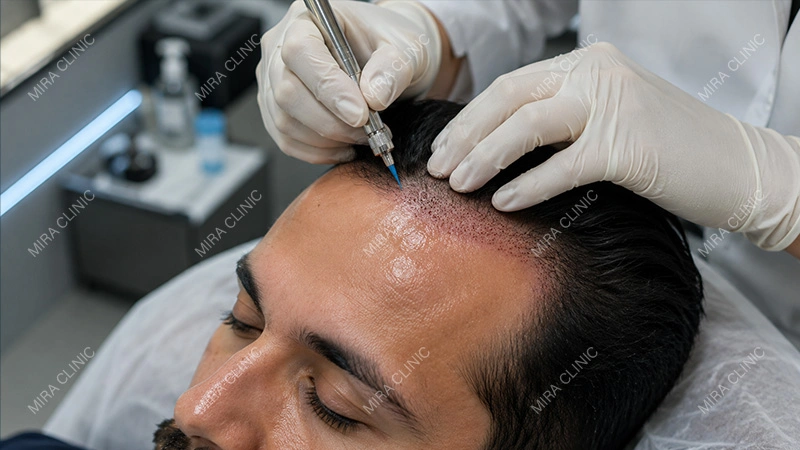
Why Blade Material Matters for Healing
Patients care about healing because it affects discomfort, confidence, and how quickly the scalp starts to look socially manageable. Blade material matters here because recipient-site quality can influence visible recovery.
How cleaner incisions may support smoother healing
Comparative commentary around sapphire FUE repeatedly connects cleaner recipient-site creation with less tissue trauma and a smoother early healing appearance in selected cases. A more delicate incision pattern may help the scalp recover in a more controlled way.
Less tissue trauma
The more refined the incision, the less unnecessary disruption there may be in the surrounding tissue. The 2021 micro-blade study supports the principle that blade design affects tissue injury, which is one reason sapphire remains clinically relevant in this discussion.
Why this may reduce visible recovery intensity
Patients often care less about the instrument itself than about redness, crusting, and whether the scalp looks “worked on.” If blade precision reduces tissue disruption, it may also improve how recovery appears in the first days and weeks.
Why scalp healing matters for visible recovery
Visible recovery is not only a comfort issue. It affects work, social activity, and travel confidence. For many international patients coming for a hair transplant in Turkey, early healing appearance matters almost as much as the long-term growth timeline.
Redness and crusting
Redness and crusting are normal after FUE-based transplantation, but the degree and appearance of this phase may be influenced by scalp biology, aftercare, and how the recipient area was created.
How recovery comfort affects patient confidence
When the early healing phase appears calmer and more controlled, patients often feel more comfortable returning to daily life. That is a practical reason why modern clinics emphasize recipient-site precision rather than only graft count.
How incision precision may affect scar visibility
Recipient-site work on the scalp is designed to heal discreetly, and precision matters for how visible the early marks are during recovery. While no honest surgeon should promise invisibility in absolute terms, finer site creation can support a more refined healing pattern.
Recipient area healing
Recipient-site healing is usually less discussed than donor extraction, but it strongly shapes the patient’s visual recovery experience. The incision environment matters here.
Why micro-precision matters in visible zones
In the frontal scalp and hairline, refinement matters more because these are the zones patients and others notice first. Precision at the incision level can therefore matter for both healing and aesthetics.
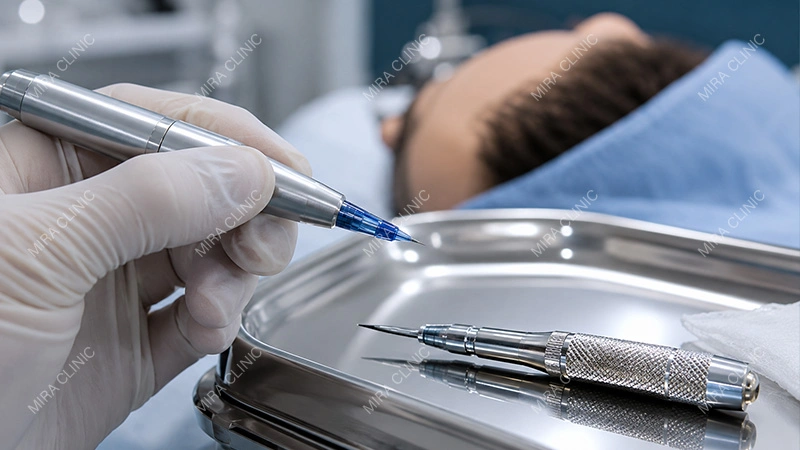
Sapphire FUE vs. Traditional FUE: What Patients Actually Notice
Patients usually do not evaluate blade material directly. They evaluate the experience and the visible outcome.
Healing appearance in the first days and weeks
The patient-facing appeal of sapphire FUE is often that recovery may look cleaner and more controlled in selected cases. This is one of the main reasons it is marketed as a premium variation of FUE.
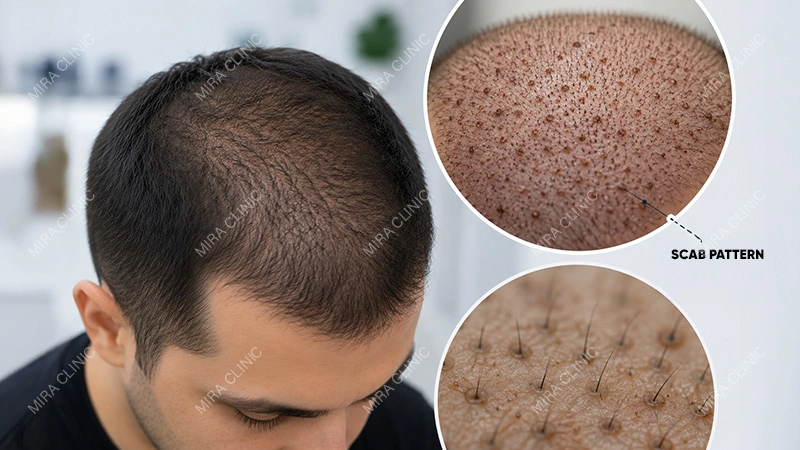
Swelling, redness, and scab pattern
These early features vary by patient and case, but recipient-site precision can influence how intense or refined the healing pattern appears. That is why blade discussion matters to patients even when they do not know the surgical details.
When recovery starts to look socially easier
A smoother visible recovery can matter a great deal to professionals and travel patients who want to return to normal life with more confidence. This is a practical, not merely cosmetic, advantage.
Differences in scalp comfort and recovery experience
While recovery comfort depends on many factors, gentler tissue handling in the recipient area may contribute to a more manageable healing experience. But this should still be discussed as a possibility, not a guarantee.
Sensitivity and tightness
Some patients describe the early scalp as tight or sensitive after any FUE-based transplant. A more delicate site-creation approach may influence how this phase feels, though patient biology remains a major variable.
Return to routine and post-op confidence
Anything that makes healing appear calmer can affect when patients feel ready to be seen publicly. That is one reason sapphire appeals strongly in image-conscious markets.
How precision can influence final aesthetic refinement
Recipient-site precision also matters for the final visual result, especially in the hairline.
Hairline design
The hairline is one of the most technically demanding parts of any transplant. Precision in angle, spacing, and site creation helps determine whether the hairline looks soft and natural or too regular.
Recipient site organization and naturalness
Naturalness depends on how recipient sites are organized, not only how many grafts are inserted. This is where sapphire’s appeal overlaps with the broader question of best ideal hair transplant technique: the best method is the one that supports the most natural execution for the patient’s scalp and goals.
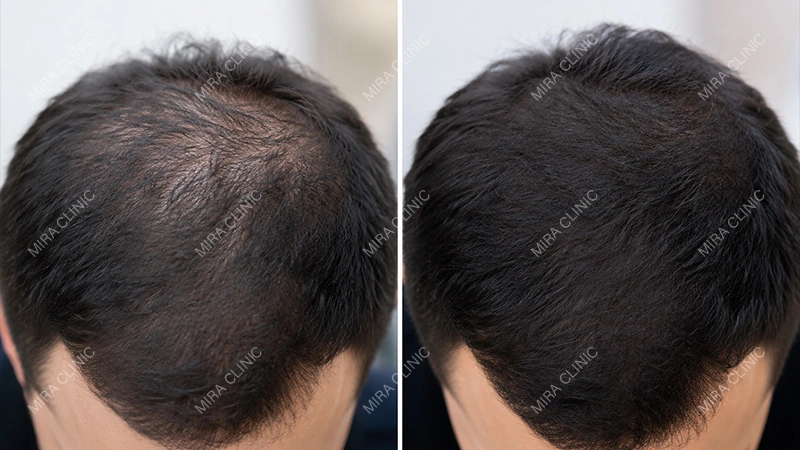
Does Sapphire FUE Improve Density or Just Healing
This is one of the most important questions in the comparison.
Why tighter site control may support denser planning
If the surgeon can create recipient sites with greater precision, that may support closer and more organized placement in selected zones, especially in the frontal scalp. But this should not be confused with unlimited density claims.
Closer placement in selected cases
Sapphire is often associated with better control in compact aesthetic areas. That may help when the goal is a refined frontal density plan rather than broad low-density coverage.
Why density still depends on donor supply
No blade can create density the donor area cannot support. The ISHRS guidelines make clear that donor characteristics and recipient planning remain central to the appearance of hair density.
Why blade quality alone does not create a fuller result
A premium blade does not replace:
- donor quality
- hair thickness
- graft survival
- hairline design
- surgical judgment
These still determine whether the transplant looks full and believable.
Surgeon skill
Expert sources consistently stress that surgeon skill outweighs blade branding when it comes to final outcomes.
Hair thickness, donor area, and scalp characteristics
Hair caliber, color contrast, curl, and donor density all influence visible fullness. This is why two patients can have different outcomes from similar graft counts.
How this affects frontal hairline work and crown area transplant planning
The frontal hairline and crown are not designed the same way. The frontal area often benefits more from micro-precision, while the crown area transplant requires a broader pattern logic because of swirl anatomy and larger visible surface.
High-visibility zones
Sapphire often has its strongest practical appeal in zones where details are judged more critically.
Why the crown needs a different design logic
The crown usually requires a different approach because the visual demand is broader and the pattern more complex. In those cases, planning and donor distribution often matter more than premium blade branding alone.
Who Is the Better Candidate for Sapphire FUE
Not every scalp needs the same technical priority.
Patients who prioritize healing appearance and refined recovery
Sapphire often appeals most to patients who care about a cleaner-looking early recovery and more refined recipient-site work.
Patients seeking high-precision hairline work
Hairline-focused cases are often where recipient-site precision becomes most visible. That is why sapphire is commonly favored in premium hairline work.
Patients comparing modern hair transplant techniques in Turkey
Patients comparing hair transplant modern techniques in Turkey are often not only comparing cost. They are comparing refinement, visible recovery, and whether the clinic operates with updated surgical tools. Sapphire fits well into that decision framework.
When traditional FUE may still be a reasonable option
Traditional FUE can still be a good and sensible option in experienced hands, particularly for broader standard cases or where budget and scale matter more than premium recipient-site branding. This is one reason it remains part of many clinics’ surgical toolkit and why some patients still view it as a more affordable hair transplant technique.
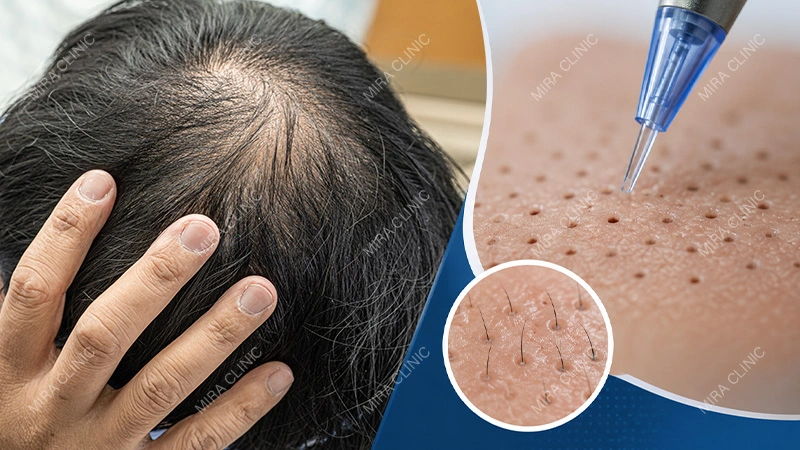
Sapphire FUE at Mira Clinic: Why Technique Must Match the Scalp
At Mira Clinic, blade choice should support the scalp rather than dominate the consultation. Sapphire is useful when it improves the case, not simply because it sounds newer.
How Mira Clinic uses blade precision as part of a broader surgical plan
Blade precision matters most when it is part of a wider system that includes:
- hairline design
- donor area strategy
- recipient density planning
- aftercare structure
That is how modern hair transplant in Turkey should be planned. The instrument is part of the system, not the whole system.
Hairline planning
A high-tech blade cannot fix a weak hairline design. The visual result still begins with planning.
Donor area management
The donor area remains the economic and biological foundation of the transplant. Mismanaging it cannot be rescued by premium recipient-site tools later.
Why high-tech tools do not replace surgeon judgment
This is the central authority point: technology helps only when used intelligently. Sapphire can support refined work, but it cannot replace good judgment, artistry, or ethical donor planning.
Artistic planning
Naturalness still depends on the surgeon’s sense of angle, line, density, and facial proportion.
Healing strategy and post-op care
Aftercare affects how well the scalp moves through recovery, regardless of blade type. Washing, activity restriction, and healing compliance still matter.
How Mira Clinic positions Sapphire FUE within modern hair transplant in Turkey
Mira Clinic’s value proposition should not be “we use sapphire, so the result is automatically better.” It should be “we use precision tools when they genuinely improve healing, site control, and aesthetic execution.” That is the high-tech position patients trust more.
Technology plus design
Modern tools work best when paired with careful design.
Precision plus recovery support
The strongest patient experience combines refined surgery with structured healing guidance.
Read more: Young Moroccan Rai Artist Cheb Aouina Chooses MIRA Clinic Istanbul for Hair Transplant
What Affects Healing Beyond the Blade
Blade material matters, but it is only one variable.
Donor area quality and extraction handling
Donor density, hair caliber, and extraction technique all influence how successful and visually strong the transplant can become.
Aftercare compliance and washing routine
Improper aftercare can undermine an excellent surgery. Washing, scratching, friction, and early activity all affect healing.
Smoking, scalp sensitivity, and healing biology
Healing differs between patients, and smoking or scalp sensitivity can influence how the post-op phase looks and feels. This is why no clinic should discuss recovery as if every scalp responds identically.
Why the best ideal hair transplant technique still depends on the individual case
There is no universal winner for every patient. The right method is the one that fits the donor area, balding pattern, hairline goal, and recovery priorities of the specific individual.
Comparison Table: Sapphire FUE vs. Traditional FUE
|
Feature |
Sapphire FUE |
Traditional FUE |
|---|---|---|
|
Blade material |
Sapphire blade |
Steel blade |
|
Recipient site precision |
Often marketed for finer control |
Standard precision |
|
Healing appeal |
Often promoted as smoother-looking in selected cases |
Effective but more conventional in recovery framing |
|
Tissue handling |
May support cleaner incision work |
Effective, but less associated with micro-refinement |
|
Hairline refinement |
Often favored in precision-led cases |
Can still perform well in experienced hands |
|
Best use case |
Precision-focused aesthetic work |
Standard broad FUE planning |
|
Depends on surgeon skill |
Yes |
Yes |
The most important takeaway from the table is that sapphire changes the recipient-site tool, not the need for strong surgical planning.
Comparison Table: What Patients Care About Most
|
Patient concern |
Sapphire FUE |
Traditional FUE |
|---|---|---|
|
Want smoother visible healing |
Often preferred |
Acceptable, but less positioned around this benefit |
|
Want refined hairline channels |
Often preferred |
Possible, but more dependent on incision style |
|
Want affordable hair transplant technique |
Usually higher-priced |
Often more budget-oriented |
|
Want a high-tech method |
Stronger fit |
More conventional positioning |
|
Want the latest modern technique |
Strong fit |
Less “advanced” perception |
This is useful because patients usually compare methods through experience and recovery, not only through surgical terminology.
Read more: Hair Transplant Timeline in Turkey: Month-by-Month Recovery and Growth
Realistic Expectations: Is Sapphire FUE Always Better
No. Sapphire is often better for precision-oriented recipient-site work, but it is not a universal shortcut to a superior transplant.
Why Sapphire FUE is often better for precision, but not magic
It can create a better technical environment for refined site creation. That matters. But it does not override poor planning, weak donor supply, or careless execution.
Why graft survival, design, and aftercare still matter most
The final result still depends more on extraction quality, graft handling, recipient planning, and healing behavior than on the blade material alone.
Why the best technique is the one that fits your scalp, donor area, and hair loss pattern
That is the most defensible and honest clinical answer. Sapphire may be the better option in many premium aesthetic cases, but the right answer is still patient-specific.
Read more: Why Do Hair Transplants Fail? 5 Critical Mistakes to Avoid Before Flying to Turkey
Final Verdict: Why Precision at the Incision Level Still Matters
Modern hair transplantation is no longer only about how many grafts were extracted. It is also about how precisely those grafts are received by the scalp. Recipient-site creation shapes healing, aesthetic refinement, and how naturally the result can be executed.
Sapphire FUE deserves attention because it can improve precision at that level. That is meaningful, especially in premium aesthetic cases and for patients who care deeply about healing appearance and hairline refinement. But the blade should still be understood as a tool, not a miracle. The strongest results in Turkey will continue to come from clinics that combine updated technology with disciplined planning, ethical donor strategy, and skilled hands.
Read more: The True Cost of Hair Transplants in Turkey (2026): Beyond the “All-Inclusive” Buzzword