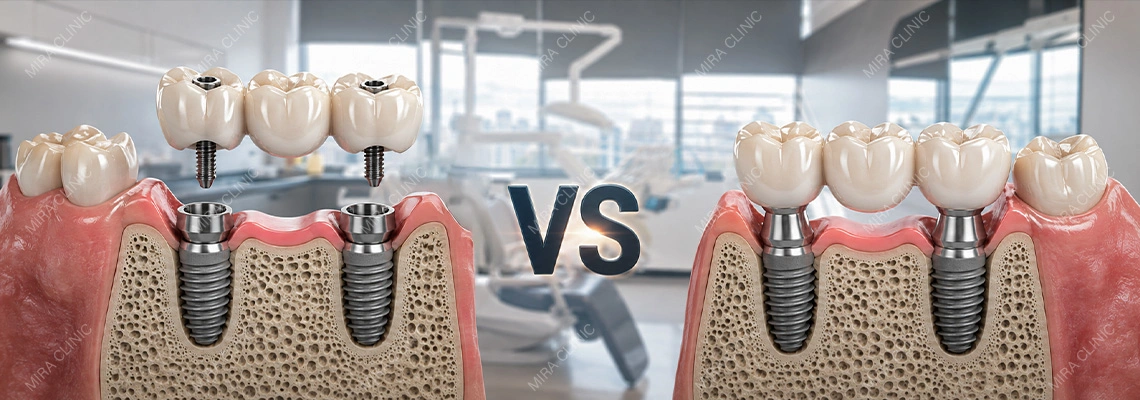
Patients comparing screw-retained vs cement-retained implant bridge options usually want to understand how their final teeth will be attached to the implants. The direct answer is that a screw-retained implant bridge is usually easier to maintain because the dentist can remove it when needed for cleaning, repair, screw tightening, or bridge replacement. A cement-retained implant bridge can look very natural in selected cases, but it may be harder to remove and requires careful cement control.
Neither option is automatically best for every patient. The right choice depends on implant position, bridge design, bite force, gum shape, smile line, maintenance needs, and the dentist’s prosthetic plan.
|
Option |
How It Is Fixed |
Maintenance Direction |
|---|---|---|
|
Screw-retained bridge |
Fixed with prosthetic screws |
Easier to remove |
|
Cement-retained bridge |
Cemented onto abutments |
Harder to retrieve |
|
Best choice |
Case-based |
Depends on design |
The patient should not choose based only on the name of the technique. The important question is how the bridge will be repaired, cleaned, adjusted, and maintained over time.
- Screw-Retained vs Cement-Retained Implant Bridge: Quick Answer
- What Is a Screw-Retained Implant Bridge?
- What Is a Cement-Retained Implant Bridge?
- Screw Retained vs Cement Retained Implants: Maintenance Differences
- Implant Bridge Maintenance: What Patients Should Expect
- Which Implant Bridge Is Better for Full-Arch Treatment?
- How Dentists Choose Between Screw-Retained and Cement-Retained Bridges
- Final Thought: Maintenance Should Be Planned Before the Final Bridge
Screw-Retained vs Cement-Retained Implant Bridge: Quick Answer
A screw-retained implant bridge is usually easier to maintain because it can be unscrewed by the dentist without cutting or damaging the bridge. A cement-retained implant bridge may be useful when screw access holes would affect appearance or bite design, but it can be harder to remove if there is a problem.
|
Question |
Screw-Retained Bridge |
Cement-Retained Bridge |
|---|---|---|
|
Removable by dentist? |
Usually yes |
Not easily |
|
Good for maintenance? |
Usually better |
More limited |
|
Screw access hole? |
Yes |
No |
|
Cement risk? |
No cement |
Cement must be controlled |
|
Aesthetic advantage? |
Case-based |
Often possible |
|
Repair access? |
Easier |
Harder |
|
Best for |
Retrievability |
Selected aesthetics/fit |
For many full-arch implant bridges, retrievability is a major advantage. If the bridge needs cleaning, repair, or screw adjustment, a screw-retained design can make maintenance more predictable.
What Is a Screw-Retained Implant Bridge?
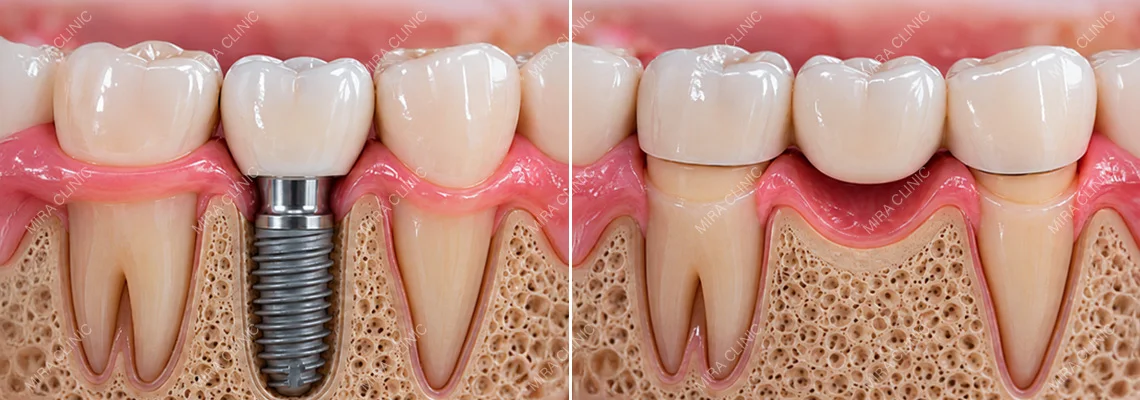
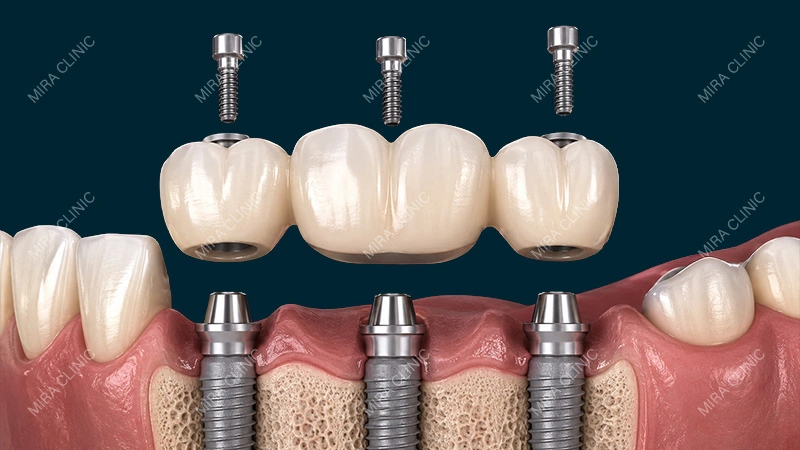
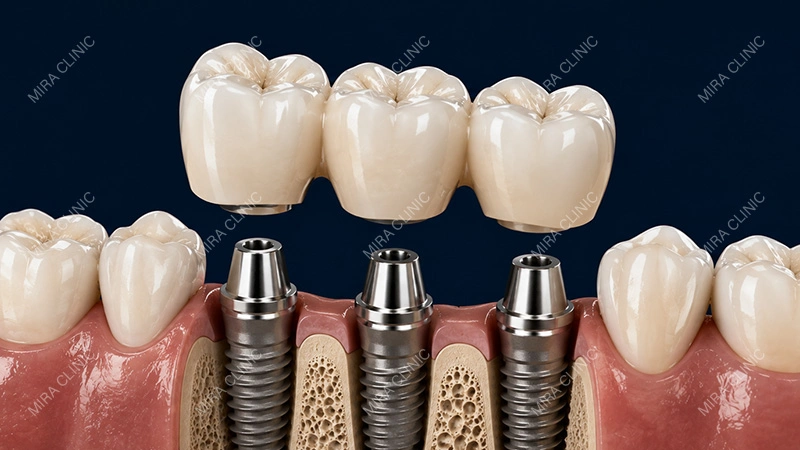
A screw retained implant bridge is attached to dental implants or multi-unit abutments with small prosthetic screws. After the bridge is fixed, the screw access holes are usually filled with a restorative material.
This design allows the dentist to remove the bridge later if needed. The patient does not remove it at home, but the dentist can access the screws during professional maintenance.
A screw-retained implant bridge may be preferred when:
- Long-term maintenance is important
- The bridge may need future repair
- The patient has a full-arch implant bridge
- The dentist wants predictable retrievability
- Excess cement risk should be avoided
- Implant angles allow safe screw access
- The bite can be designed around access holes
The main advantage is serviceability. If a screw loosens, a tooth chips, or deep cleaning is needed, the bridge can often be removed and repaired more easily.
What Are the Possible Limitations?
A screw-retained bridge needs screw access holes. In some cases, these holes may appear on the chewing surface, which is usually acceptable. In front teeth, however, screw access may affect appearance if implant angulation is not ideal.
Possible limitations include:
- Visible access hole in aesthetic areas
- Need for precise implant positioning
- Possible screw loosening
- Chipping around access filling
- More complex laboratory planning
These limitations can often be managed with careful implant planning, multi-unit abutments, angled screw channels, and proper bridge design.
What Is a Cement-Retained Implant Bridge?
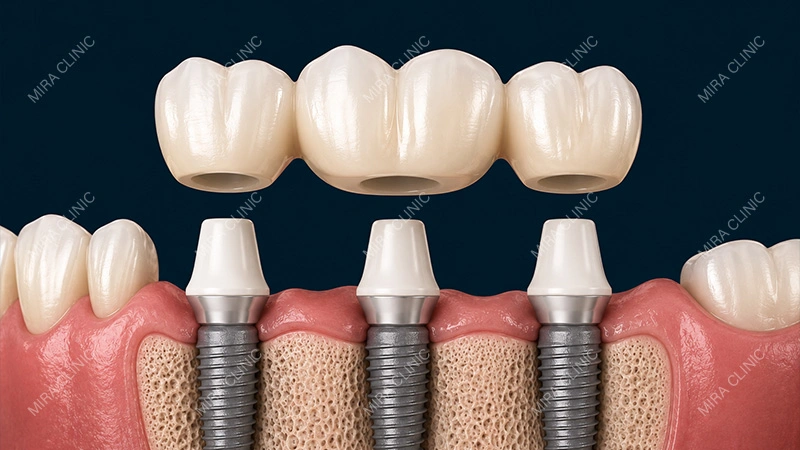
A cement retained implant bridge is fixed by cementing the bridge onto implant abutments. This means there is no visible screw access hole through the biting or front surface of the restoration.
Cement-retained designs may be used when implant position makes screw access difficult or when appearance is a major concern. They can also help compensate for certain implant angulation issues.
A cement-retained implant bridge may be considered when:
- Screw access would appear in an aesthetic area
- Implant angulation is not ideal for screw retention
- The dentist wants a more crown-like appearance
- Passive fit can be improved with cementation
- The case is designed for controlled cement margins
The main concern is excess cement. If cement remains under the gum around implants, it can irritate the tissues and may contribute to inflammation. This is why cement-retained bridges require careful margin design, cement selection, cement removal, and follow-up.
What Are the Possible Limitations?
A cement-retained bridge is harder to retrieve. If the bridge needs repair, removal may be difficult and may sometimes damage the restoration.
Possible limitations include:
- Difficult removal
- Risk of excess cement
- Harder repair access
- Possible decementation
- More difficult maintenance if problems occur
- Need for very careful cement cleanup
Cement-retained bridges can work well in selected cases, but the cementation technique must be controlled carefully.
Screw Retained vs Cement Retained Implants: Maintenance Differences
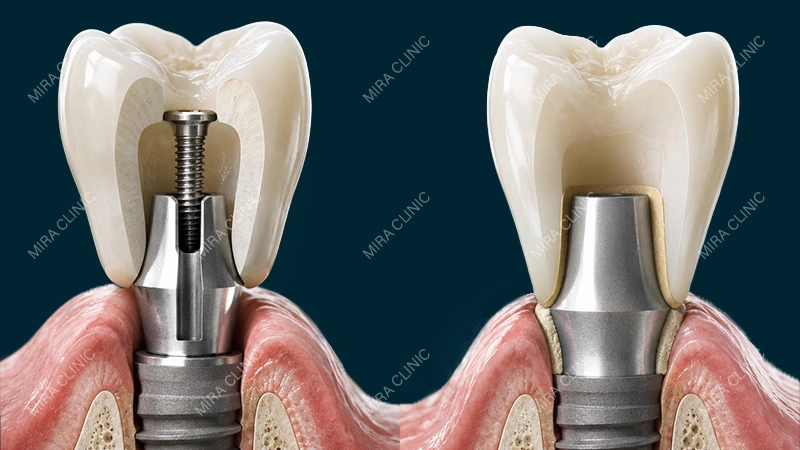
When comparing screw retained vs cement retained implants, maintenance is one of the biggest differences. Implant bridges are not only judged by how they look on the first day. They also need to be cleaned, checked, repaired, and maintained over years.
|
Maintenance Factor |
Screw-Retained |
Cement-Retained |
|---|---|---|
|
Professional removal |
Easier |
Difficult |
|
Deep cleaning access |
Better when removed |
Limited |
|
Screw tightening |
Direct access |
More difficult |
|
Bridge repair |
Often easier |
May require cutting |
|
Cement-related inflammation |
Avoided |
Possible risk |
|
Access hole maintenance |
Needed |
Not needed |
|
Long-term serviceability |
Strong advantage |
Case-dependent |
Screw-retained bridges usually have a maintenance advantage because they can be retrieved. Cement-retained bridges may have an aesthetic advantage in selected cases, but maintenance access can be more complicated.
Why Retrievability Matters
Retrievability means the dentist can remove the bridge without destroying it. This matters because implant bridges may need attention over time.
Retrievability helps when:
- A screw loosens
- The bridge needs repair
- A ceramic tooth chips
- The gums need deep cleaning
- The bite needs major adjustment
- The bridge needs laboratory polishing
- A component needs replacement
A fixed implant bridge is a long-term restoration. The easier it is to service, the easier it is to manage future maintenance.
Implant Bridge Maintenance: What Patients Should Expect
Implant bridge maintenance is essential whether the bridge is screw-retained or cement-retained. Even a fixed bridge must be cleaned carefully around the implants and under the prosthesis.
Patients may need:
- Professional check-ups
- Bite adjustment
- X-rays when needed
- Cleaning around implants
- Cleaning under the bridge
- Screw checks
- Gum inflammation checks
- Bridge polishing or repair
- Home hygiene instructions
At home, patients may be advised to use:
- Water flosser
- Interdental brushes
- Super floss or floss threaders
- Soft toothbrush
- Low-abrasive toothpaste
- Antibacterial mouth rinse if recommended
A screw-retained bridge may be easier for the dentist to remove during professional maintenance. A cement-retained bridge requires careful monitoring around the margins because cement remnants are a known concern.
How Often Should an Implant Bridge Be Checked?
Many patients need regular implant maintenance visits every few months at first, then according to gum health, hygiene, bite force, and risk level. Patients with smoking history, gum disease, diabetes, bruxism, or full-mouth bridges may need closer follow-up.
The exact schedule should be decided by the dentist.
Which Implant Bridge Is Better for Full-Arch Treatment?
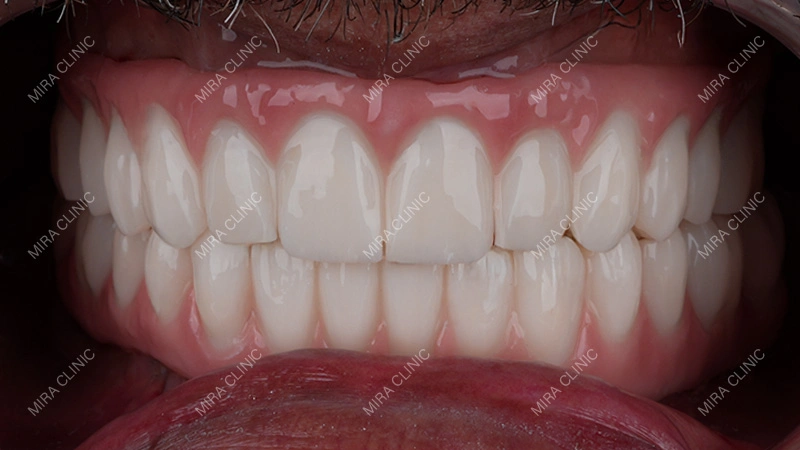
For full-arch implant bridges, screw-retained designs are often preferred because they are easier to maintain and retrieve. This is especially important in All-on-4, All-on-6, and full-mouth implant treatments, where the bridge may need future adjustments or repairs.
A screw-retained full-arch bridge may be useful because:
- The bridge can be removed professionally
- Screws can be checked
- The underside can be cleaned
- Repairs are easier
- No cement is trapped under the gum
- Long-term maintenance is more predictable
A cement-retained bridge may still be considered in selected cases, especially when implant angles or aesthetics make screw access difficult. However, for larger bridges, retrievability becomes more important.
The final choice should be made during prosthetic planning, not after implants are already placed.
How Dentists Choose Between Screw-Retained and Cement-Retained Bridges
Dentists choose between screw-retained and cement-retained implant bridges based on implant position, angulation, bridge material, bite, smile line, gum shape, hygiene access, and long-term repair needs.
The dentist may evaluate:
- Implant angle
- Implant depth
- Gum thickness
- Smile line
- Bite force
- Bridge length
- Material choice
- Screw access position
- Aesthetic zone
- Maintenance access
- Risk of gum inflammation
- Need for future retrievability
A screw-retained bridge may be selected when retrievability and maintenance are the priority. A cement-retained bridge may be selected when screw access would compromise appearance or when the prosthetic design requires it.
The best option is not the one that sounds more modern. It is the one that fits the implant position and long-term maintenance plan.
Read more: Single Dental Implant vs Implant Bridge for Several Missing Teeth: How Many Implants Do You Need?
Final Thought: Maintenance Should Be Planned Before the Final Bridge
A dental implant bridge is not only about replacing missing teeth. It must also be maintainable. A screw-retained bridge usually offers easier professional removal, repair, and cleaning access. A cement-retained bridge can be useful in selected aesthetic or angulation cases, but cement control and retrieval limitations must be considered.
Patients should ask how the bridge will be removed if needed, how it will be cleaned, what happens if a screw loosens or a tooth chips, and whether the final design supports long-term maintenance.
A well-designed implant bridge should look natural, feel stable, and be serviceable over time.
Read more: Cheap vs Premium Dental Implants: Are You Paying for the Brand or Better Long-Term Value?