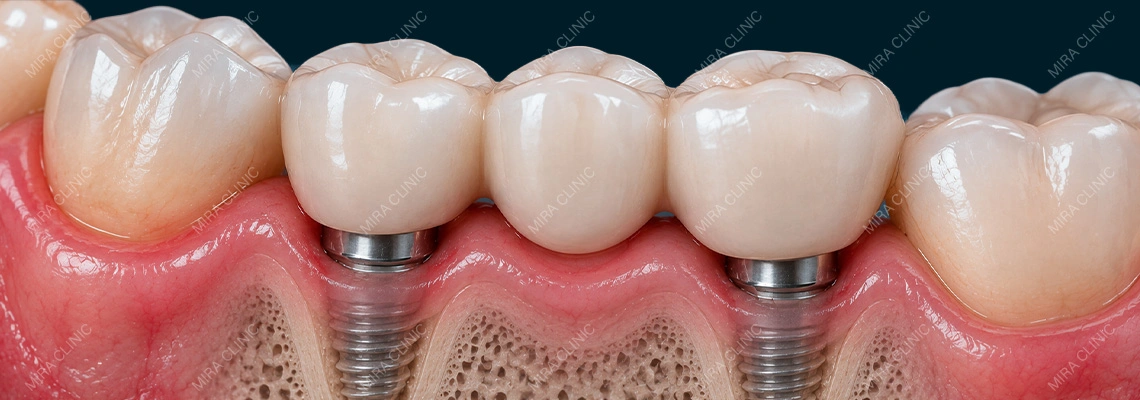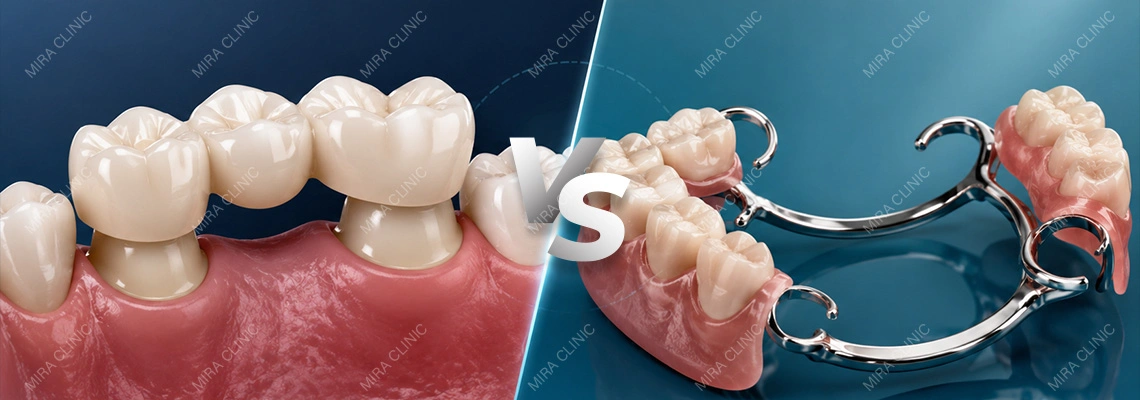
Patients comparing dental bridge vs partial denture usually want to know which option feels more stable when several teeth are missing. The direct answer is that a fixed bridge usually feels more stable because it is attached to teeth or implants and does not come in and out. A partial denture is removable, usually more affordable, and may be useful when missing teeth are in different areas or when a fixed bridge is not suitable.
The best choice depends on how many teeth are missing, where the gaps are, the strength of the remaining teeth, gum condition, bone support, bite force, budget, and whether the patient wants a fixed or removable solution.
|
Option |
Stability |
Best For |
|---|---|---|
|
Fixed bridge |
Usually higher |
Teeth missing in one area |
|
Partial denture |
Moderate |
Teeth missing in different areas |
|
Implant bridge |
Highest in selected cases |
Full-arch or larger gaps |
|
Final decision |
Case-based |
Exam + X-ray |
The goal is not only to replace missing teeth. The goal is to restore chewing, speech, appearance, and comfort with a treatment that fits the patient’s mouth.
- Dental Bridge vs Partial Denture
- What Is a Dental Bridge?
- What Is a Partial Denture?
- Partial Denture vs Bridge: Which Feels More Stable?
- Bridge or Denture for Missing Teeth: How Doctors Decide
- When Is a Dental Bridge the Better Choice?
- When Is a Partial Denture the Better Choice?
- What Affects the Treatment Choice?
- Price Comparison: Dental Bridge vs Partial Denture
- Which Option Is Better for Chewing?
- Which Option Looks More Natural?
- What Happens If Missing Teeth Are Not Replaced?
- How to Choose the Right Option for Several Missing Teeth
Dental Bridge vs Partial Denture
A dental bridge is usually more stable than a partial denture because it is fixed in place and does not need to be removed at home. A partial denture is removable, may feel less stable at first, and may need adjustment, but it can replace several missing teeth across different areas of the mouth.
|
Question |
Dental Bridge |
Partial Denture |
|---|---|---|
|
Fixed or removable? |
Fixed |
Removable |
|
Feels more stable? |
Usually yes |
Usually less |
|
Replaces teeth in different areas? |
Limited |
Yes |
|
Needs support teeth? |
Often yes |
Usually yes |
|
Lower starting cost? |
Usually no |
Usually yes |
|
Easier to repair/add teeth? |
Not always |
Often yes |
|
Best when |
Gaps are localized |
Gaps are multiple |
A bridge may feel more natural for chewing because it stays in place. A partial denture may be a practical option when several teeth are missing in different parts of the mouth or when the remaining teeth cannot support a bridge safely.
What Is a Dental Bridge?
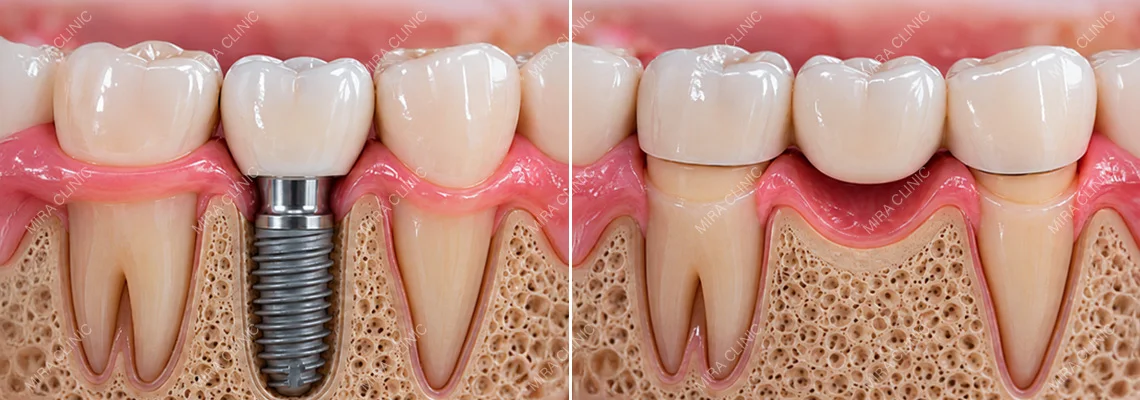
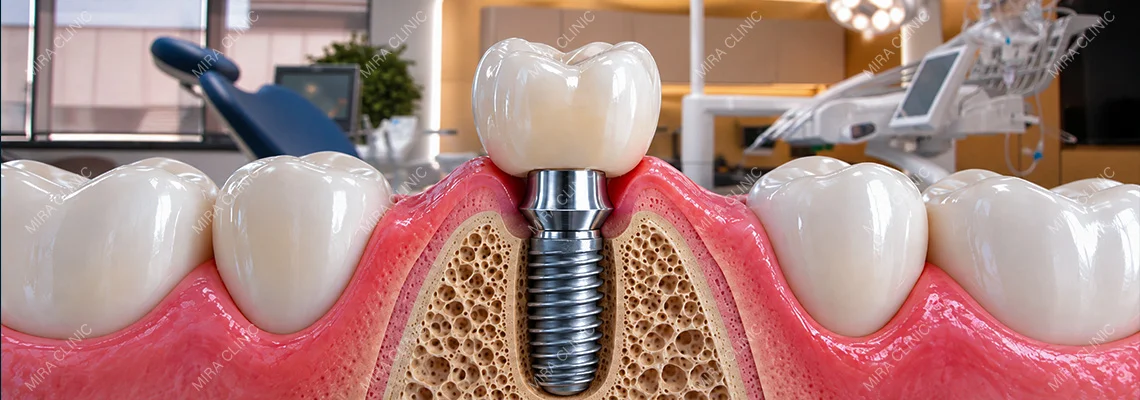
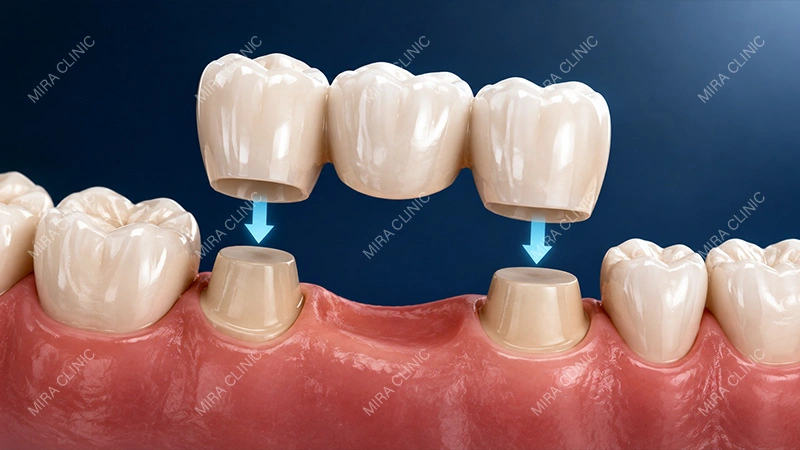
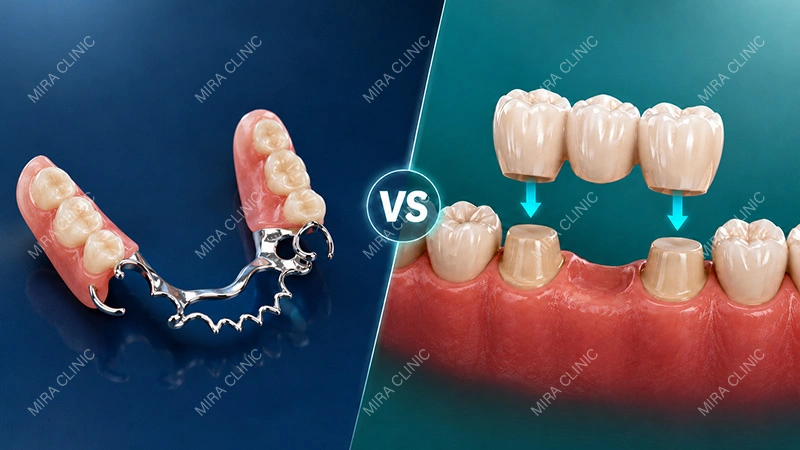
A dental bridge is a fixed restoration used to replace one or more missing teeth. It fills the gap with artificial teeth connected to support teeth or dental implants.
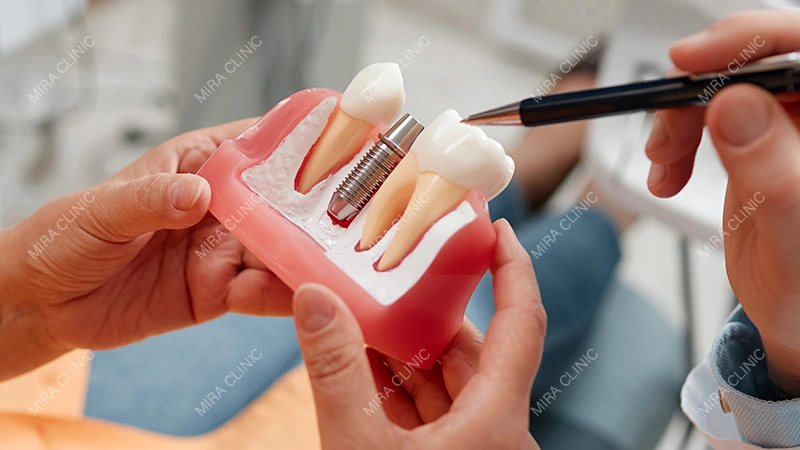
A traditional bridge usually uses the teeth on both sides of the gap as support. These teeth may need to be reshaped and covered with crowns to hold the bridge. An implant-supported bridge uses dental implants instead of natural teeth for support.
A dental bridge may be suitable when:
- Several teeth are missing in one area
- The support teeth are strong enough
- The bite can be balanced safely
- The patient wants a fixed solution
- The gap is not too long for a tooth-supported bridge
- The patient wants better stability than a removable denture
A bridge can feel stable because it does not move in and out during the day. However, it must be planned carefully because weak support teeth can affect long-term success.
What Is a Partial Denture?
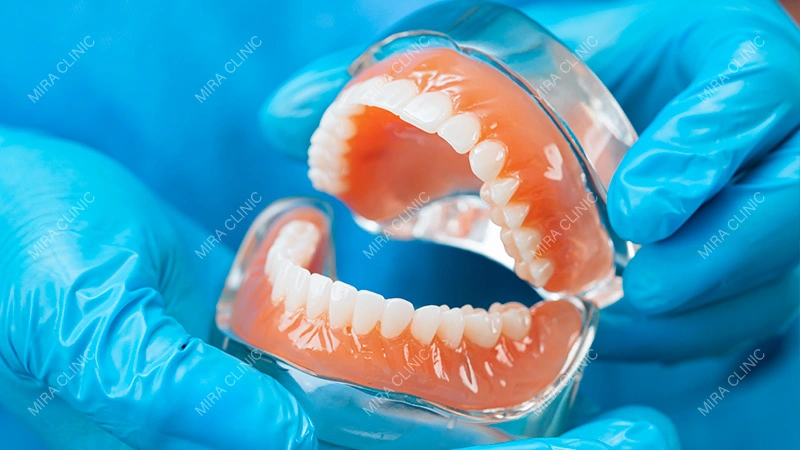
A partial denture is a removable appliance that replaces one or more missing teeth while some natural teeth remain. It may use clasps, rests, acrylic, metal framework, or flexible material to stay in place.
Unlike a bridge, a partial denture can be taken out for cleaning and sleeping. It can replace missing teeth in different areas of the mouth, which makes it useful when the gaps are not next to each other.
A partial denture may be suitable when:
- Teeth are missing in several areas
- A fixed bridge is not possible
- Support teeth are weak
- The patient wants a lower-cost option
- The patient needs a temporary or transitional solution
- Future tooth loss is expected
- Implant treatment is not suitable or not preferred
A partial denture may need time to feel comfortable. Some patients adapt quickly, while others need several adjustments for better fit, speech, and chewing.
Partial Denture vs Bridge: Which Feels More Stable?
When comparing partial denture vs bridge, the bridge usually feels more stable because it is fixed. It does not move during normal speaking or chewing when designed correctly. A partial denture can also be stable, but it may move slightly because it rests on gums and remaining teeth.
|
Stability Factor |
Bridge |
Partial Denture |
|---|---|---|
|
Movement during chewing |
Usually minimal |
Possible |
|
Removal at home |
No |
Yes |
|
Support type |
Teeth or implants |
Teeth + gums |
|
Adaptation period |
Usually shorter |
Often longer |
|
Maintenance |
Brush/floss aids |
Remove and clean |
|
Repair flexibility |
More limited |
Often easier |
A partial denture may feel less stable when the patient has few remaining teeth, weak back teeth, poor gum support, or strong bite forces. A bridge may feel more stable, but only if the support teeth or implants are strong enough.
Stability depends on the full mouth, not only the replacement teeth.
Bridge or Denture for Missing Teeth: How Doctors Decide
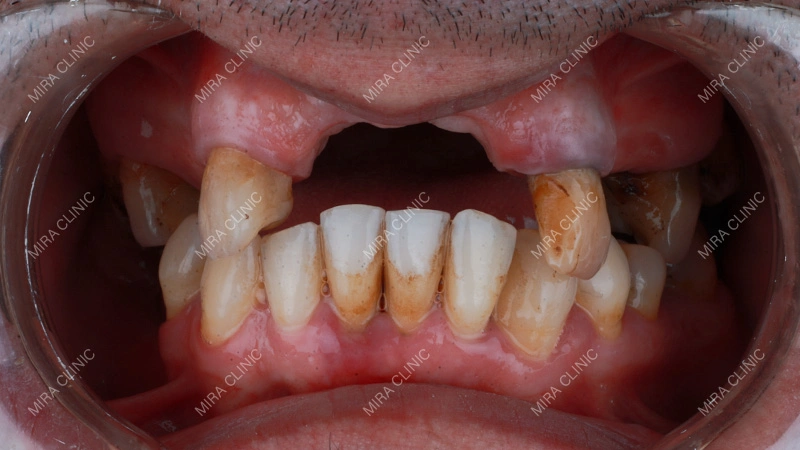
When deciding between bridge or denture for missing teeth, the dentist evaluates the number of missing teeth, the position of the gaps, the health of support teeth, gum condition, bone support, bite force, and patient expectations.
The dentist may check:
- How many teeth are missing
- Whether gaps are in one area or several areas
- Strength of remaining teeth
- Gum and bone support
- Bite pressure
- Tooth mobility
- Decay risk
- Cleaning ability
- Smile appearance
- Budget
- Long-term maintenance
- Whether implants are possible
A bridge may be recommended when the missing teeth are in one connected area and the support teeth or implants can carry the chewing force. A partial denture may be recommended when teeth are missing in multiple areas or when support teeth are not suitable for a fixed bridge.
The decision should be based on function, stability, and long-term safety, not only on price.
When Is a Dental Bridge the Better Choice?
A dental bridge may be the better choice when the patient wants a fixed solution and the missing teeth are located in one area. It may also be suitable when the support teeth already need crowns or when dental implants are used to support a larger bridge.
A bridge may be better when:
- The gap is localized
- Support teeth are strong
- The patient wants fixed teeth
- The bite can be distributed safely
- The patient does not want a removable appliance
- The bridge can be cleaned properly
- The treatment plan is predictable
A fixed bridge can improve confidence because the patient does not need to remove it. However, if natural teeth are used as support, those teeth must be healthy enough to carry the bridge.
When Is a Partial Denture the Better Choice?
A partial denture may be better when teeth are missing in different areas or when a fixed bridge would require too much stress on weak support teeth. It may also be used as a more affordable or temporary option.
A partial denture may be better when:
- Several gaps are spread across the mouth
- Support teeth are not strong enough for a bridge
- The patient wants a lower-cost option
- Future extractions may be expected
- Implants are not possible
- The patient needs a removable solution
- The treatment needs to be easier to modify
A partial denture can replace multiple missing teeth with one appliance. The main limitation is that it may not feel as fixed or natural as a bridge, especially during the adaptation period.
Read more: Full Mouth Dental Implants Turkey Price: Costs, Packages, and Candidate Guide
What Affects the Treatment Choice?
The choice between a dental bridge and partial denture depends on clinical and practical factors. A stable treatment must work with the patient’s existing teeth, gums, bite, and daily habits.
Important factors include:
- Number of missing teeth
- Gap location
- Condition of support teeth
- Gum disease history
- Bone level
- Bite force
- Jaw relationship
- Smile line
- Cleaning ability
- Budget
- Travel schedule
- Patient comfort with removable teeth
If the remaining teeth are strong, a bridge may be possible. If the remaining teeth are weak or gaps are spread out, a partial denture may be safer and more flexible.
A dentist should explain why one option is more stable or more suitable for the specific mouth, not only describe the treatment in general.
Price Comparison: Dental Bridge vs Partial Denture
Price is not the only factor, but it helps patients understand the difference between a fixed and removable treatment. A removable denture usually has a lower starting cost. A fixed bridge, especially an implant-supported full-arch bridge, usually costs more because it involves implants, surgery, abutments, and a final fixed restoration.
|
Treatment Option |
Example Price Direction |
|---|---|
|
Full dentures installation |
Around €500 |
|
All-on-4 fixed acrylic bridge |
Around €5,200–€10,000 |
|
All-on-4 fixed porcelain bridge |
Around €5,500–€10,500 |
|
All-on-4 fixed zirconia bridge |
Around €6,000–€12,000 |
|
All-on-6 fixed acrylic bridge |
Around €6,000–€12,000 |
|
All-on-6 fixed porcelain bridge |
Around €6,500–€12,500 |
|
All-on-6 fixed zirconia bridge |
Around €7,000–€14,000 |
|
Zygomatic implants with fixed bridge |
Around €15,000–€20,000 |
These prices are treatment examples and should not be read as a final quote for every patient. The total cost can change based on the number of missing teeth, implant count, material, bone condition, extractions, bone grafting, sinus lift, temporary teeth, and follow-up.
A lower denture cost may be attractive, but the patient should also consider stability, comfort, chewing ability, and long-term maintenance.
Read more: Dental Implants Cost in Turkey: Prices for 4 Missing Teeth, 6 Missing Teeth, and Cracked Teeth Cases
Which Option Is Better for Chewing?
A fixed bridge usually gives stronger chewing stability than a removable partial denture because it is attached to teeth or implants. A partial denture can improve chewing compared with leaving gaps untreated, but it may not feel as strong as fixed teeth.
Chewing comfort depends on:
- Fit of the appliance
- Number of support teeth
- Back tooth support
- Bite balance
- Gum stability
- Material quality
- Patient adaptation
Patients missing back teeth often care more about chewing than appearance. In these cases, the dentist must check whether the partial denture can stay stable during chewing or whether a bridge or implant-supported bridge would be more predictable.

Which Option Looks More Natural?
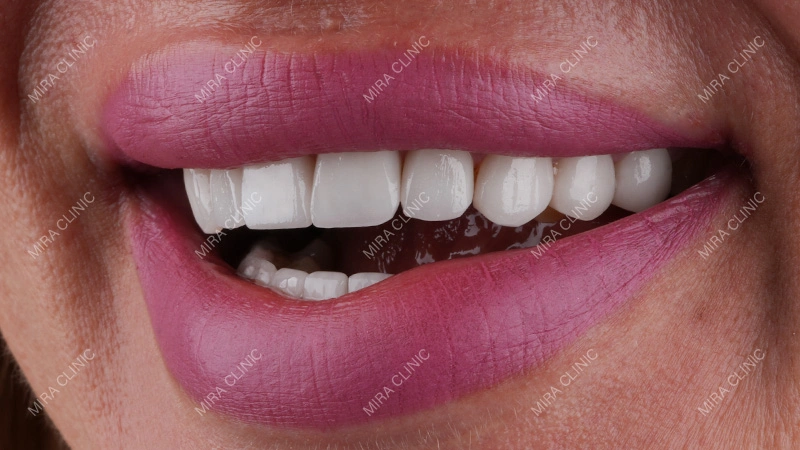
Both a bridge and partial denture can look natural when designed well. A bridge may feel and appear more like natural teeth because it is fixed. A partial denture can also restore appearance, but clasps or removable parts may sometimes be visible depending on the design.
Appearance depends on:
- Tooth color
- Gum shape
- Smile line
- Material
- Clasp position
- Bridge or denture design
- Laboratory quality
For front teeth, appearance may become a major factor. For back teeth, stability and chewing may matter more.
The best option should balance appearance with function.
Read more: Patient Experience with Veneers in Turkey: Real Stories, Results, and What to Expect
What Happens If Missing Teeth Are Not Replaced?
If missing teeth are not replaced, nearby teeth may shift, the bite may change, chewing may become harder, and the opposite teeth may move into the gap. Missing back teeth can also place more pressure on the remaining teeth.
Possible consequences include:
- Tooth shifting
- Bite changes
- Food trapping
- Chewing difficulty
- Speech changes
- Jaw discomfort
- More pressure on remaining teeth
- Bone and gum changes in the missing area
Not every missing tooth needs the same type of replacement, but several missing teeth should be evaluated before the bite changes become harder to correct.
Read more: What Happens in Your Mouth After Dental Implants? From the Implant and Abutment to the Final Bridge
How to Choose the Right Option for Several Missing Teeth
The right choice depends on stability, support, comfort, cost, and long-term planning. A bridge may be better when the patient wants fixed teeth and has strong support teeth or implants. A partial denture may be better when missing teeth are spread out, when support teeth are weak, or when the patient wants a more affordable removable option.
The decision should be based on a dental examination, X-rays, bite evaluation, gum health, and a clear discussion of the patient’s expectations.
A stable treatment is not always the most expensive one. It is the option that matches the patient’s mouth and can be maintained safely.
Read more: Root Canal and Crown vs Dental Implant: Can the Natural Tooth Still Be Saved?