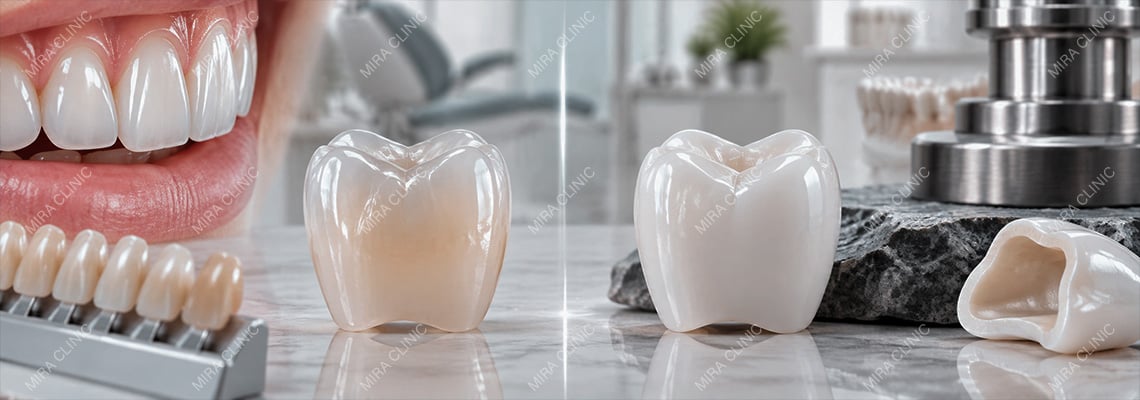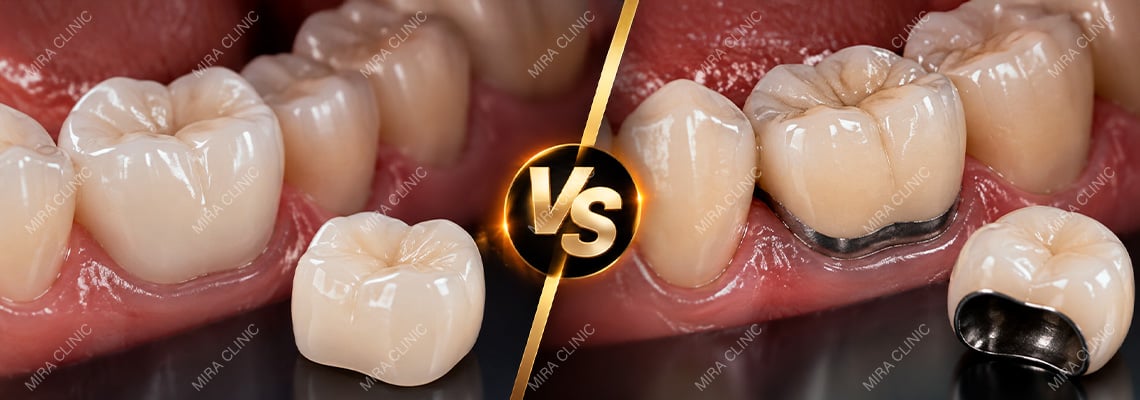
For most single back teeth exposed to heavy chewing, monolithic zirconia is usually the stronger modern choice because it combines high fracture resistance with no separate porcelain layer that can chip away from a metal core. PFM crowns remain clinically reliable, especially in selected bridge or limited-space situations. The better crown, however, depends on bite force, grinding, remaining tooth structure, available clearance, opposing teeth, and the quality of crown design and finishing. Clinical studies show that both zirconia-based and PFM posterior crowns can achieve high survival rates when properly planned and fitted.
- Why Back Teeth Need a Different Crown Material Strategy
- Zirconia vs PFM Crowns: Which Is Stronger for Chewing?
- Which Crown Is More Likely to Chip or Fracture?
- Does Zirconia Require Less Tooth Reduction Than PFM?
- Does Zirconia Wear Down the Opposing Tooth?
- What If You Grind Your Teeth or Have a Heavy Bite?
- Zirconia vs Porcelain-Fused-to-Metal Crowns: Appearance, Gumline, and Long-Term Changes
- When Can PFM Still Be the Better Choice?
- Zirconia vs PFM for Back Teeth: Side-by-Side Decision Guide
- Final Verdict: Which Crown Handles Chewing Better?
Why Back Teeth Need a Different Crown Material Strategy
Molars and premolars do most of the heavy work when you chew. A crown placed on a back tooth therefore has to tolerate repeated vertical pressure, lateral forces during grinding movements, and potentially much higher loads in patients who clench or grind their teeth.
This is why the question is not simply, “Which crown looks better?”
For posterior teeth, the more useful questions are:
- Which material tolerates chewing forces better?
- Which is less likely to chip?
- How much natural tooth must be removed?
- Does the patient grind or clench?
- What material is on the opposing tooth?
- Is this a single crown or part of a bridge?
- Is there enough vertical space for the restoration?
These factors often make zirconia vs porcelain fused to metal crowns a more clinically relevant comparison for molars than comparing highly aesthetic anterior ceramics.
What exactly is a zirconia crown?
Zirconia is a high-strength ceramic made from zirconium dioxide.
For posterior teeth, dentists commonly use monolithic zirconia, meaning that the crown is milled primarily as one solid zirconia restoration rather than using a weaker cosmetic porcelain layer over the entire chewing surface.
That construction is one reason zirconia performs well under heavy posterior loads.
What is a PFM crown?
PFM stands for porcelain fused to metal.
A PFM crown has:
- a metal substructure that provides strength, and
- tooth-colored porcelain fused over the metal to improve appearance.
PFM crowns have decades of clinical use behind them. Their metal framework is strong, but the porcelain covering can become the weaker part of the restoration under certain types of load.
Zirconia vs PFM Crowns: Which Is Stronger for Chewing?
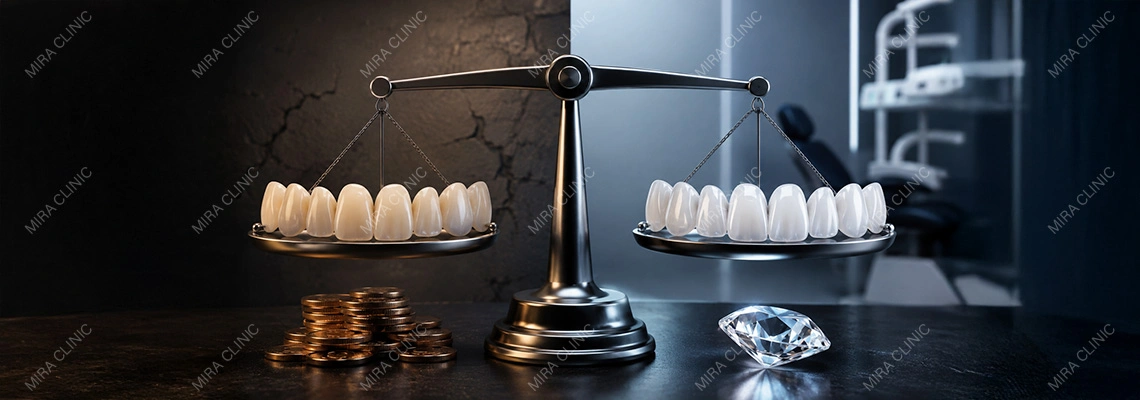
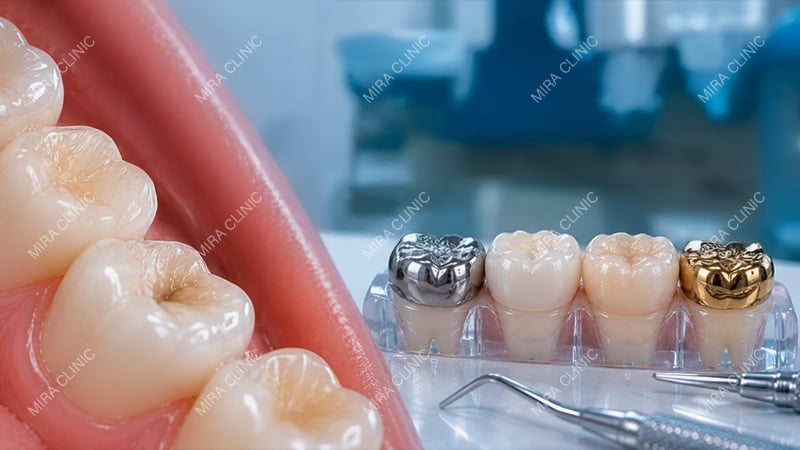
If the main concern is chewing strength on a single molar, monolithic zirconia usually has the practical advantage.
Zirconia is highly resistant to fracture, and because monolithic zirconia does not depend on a separate veneering porcelain layer over the biting surface, there is less concern about that outer layer chipping away.
PFM crowns also tolerate substantial chewing forces. Their metal framework is extremely dependable, which is why metal-ceramic restorations remained a standard option for posterior dentistry for decades.
The difference is in how the two restorations are constructed.
|
Factor |
Monolithic Zirconia |
PFM |
|---|---|---|
|
Core structure |
High-strength ceramic |
Metal |
|
Outer porcelain layer required |
No, not necessarily |
Yes |
|
Heavy chewing resistance |
Excellent |
Very good |
|
Porcelain chipping risk |
Lower with monolithic design |
Present |
|
Metal-free |
Yes |
No |
|
Posterior single crowns |
Common modern choice |
Established option |
|
Long-span applications |
Case dependent |
Still useful in selected cases |
A five-year randomized trial comparing posterior zirconia-based and metal-ceramic single crowns found very similar survival rates—approximately 97.7% for zirconia-based crowns and 97.4% for PFM crowns. This shows an important point: PFM is not a weak material. Both can work very well when the case is properly selected.
A separate long-term private-practice analysis of more than 2,000 posterior crowns also reported very similar survival probabilities for zirconia-based and PFM restorations over roughly 7.4 years.
So the question is not simply whether PFM is “strong” and zirconia is “stronger.” The design and likely failure mode matter just as much.
Which Crown Is More Likely to Chip or Fracture?
This is one of the biggest differences patients should understand.
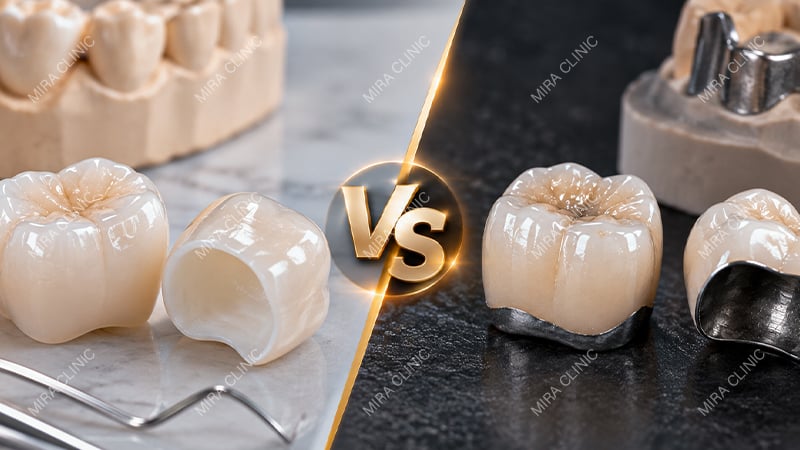
Monolithic zirconia
With a monolithic zirconia crown, the chewing surface is primarily one material.
There is therefore no conventional outer porcelain veneer covering a metal coping that can separate or chip in the same way as a traditional PFM crown.
This is especially useful for:
- molars
- patients with strong bites
- patients who clench
- patients who have previously chipped porcelain restorations
PFM
The metal framework itself is very strong.
The potential weak point is the porcelain fused over the metal. Under repeated chewing forces, parafunctional habits, or unfavorable bite contacts, porcelain can chip while leaving the metal underneath intact.
That does not automatically mean the crown has failed completely. A small chip may sometimes be polished or repaired. Larger fractures can require replacement.
Clinical research confirms that ceramic chipping can occur with both veneered zirconia and PFM constructions, and the exact rate varies significantly between studies and restoration designs.
This distinction is why monolithic zirconia is important when discussing posterior crowns. Older studies involving zirconia frameworks covered with porcelain should not automatically be interpreted as representing the performance of today's full-contour monolithic zirconia crowns.
Does Zirconia Require Less Tooth Reduction Than PFM?
Potentially, yes—but this depends on the zirconia system, crown design, tooth position, and manufacturer requirements.
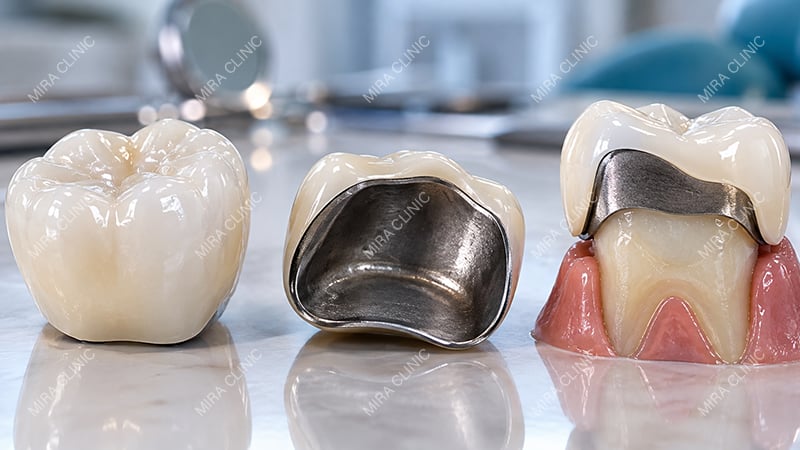
A PFM crown needs sufficient room for both:
- the metal framework
- the porcelain layered over it
This can require more restorative space in areas where porcelain must maintain adequate thickness.
Monolithic zirconia does not require the same two-layer construction. That can allow a dentist to use a comparatively thinner restoration in some posterior situations while still maintaining high material strength.
This can become important when a molar has:
- limited vertical clearance
- limited remaining tooth structure
- a short clinical crown
- a strong opposing bite
However, “zirconia always requires less drilling” would be too simplistic.
The correct preparation depends on the specific crown, bite, margin design, and clinical condition of the tooth. In some extremely limited-space posterior situations, a metal occlusal design may still make PFM or another metal-based restoration useful.
Dentists discussing posterior crown selection on professional forums also frequently raise this exact issue: zirconia is commonly preferred for single posterior crowns, while PFM with exposed metal occlusally can still have a role when space is unusually limited.
Does Zirconia Wear Down the Opposing Tooth?
This is one of the most common patient concerns about zirconia.
Because zirconia is very hard, patients sometimes assume that it must automatically grind away the opposing natural tooth.
The reality is more nuanced.
Surface finish matters enormously.
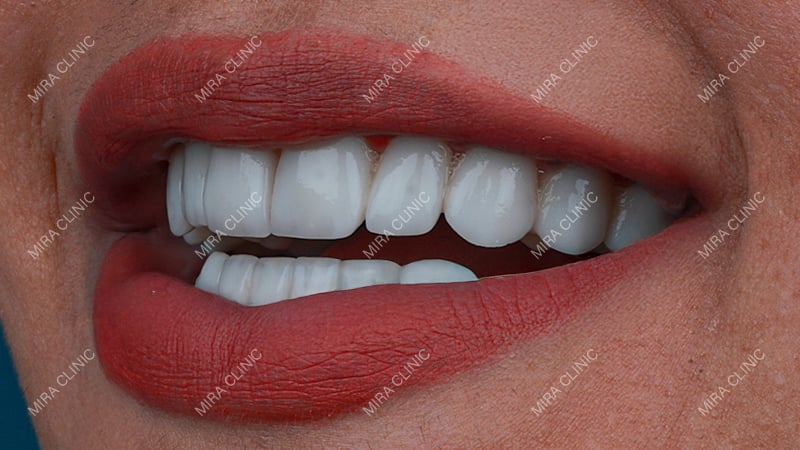
Research has consistently found that well-polished monolithic zirconia produces substantially more favorable wear behavior than rough or inadequately finished zirconia. A systematic review found antagonist enamel wear to be lower against polished zirconia, and later reviews similarly emphasized the importance of polishing rather than relying only on glazing.
A 2024 umbrella review found polished monolithic zirconia produced relatively favorable antagonist-wear results compared with several other ceramic materials.
At the same time, the evidence is not perfectly uniform. More recent reviews still report that ceramic crowns—including zirconia and metal-ceramic restorations—can create measurable opposing enamel wear and that study methods vary considerably.
So the practical answer is:
The quality of finishing and bite adjustment matters almost as much as the material itself.
A strong crown that is left rough or placed in an excessively heavy bite can create problems regardless of how impressive the material specification sounds.
Read more: Dental Crown vs Onlay for a Cracked Back Tooth: Does the Whole Tooth Need Covering?
What If You Grind Your Teeth or Have a Heavy Bite?
Patients with bruxism require special consideration. Grinding introduces repeated lateral forces that differ from the vertical forces of normal chewing.
For patients with substantial posterior bite force, monolithic zirconia is often favored because of its fracture resistance and absence of a conventional veneering porcelain layer.
However, choosing zirconia does not eliminate the effects of bruxism.
The dentist still needs to evaluate:
- where the strongest contacts occur
- whether the crown is hitting prematurely
- the condition of the opposing tooth
- existing restorations
- available restorative thickness
- evidence of grinding or clenching
- whether a night guard is indicated
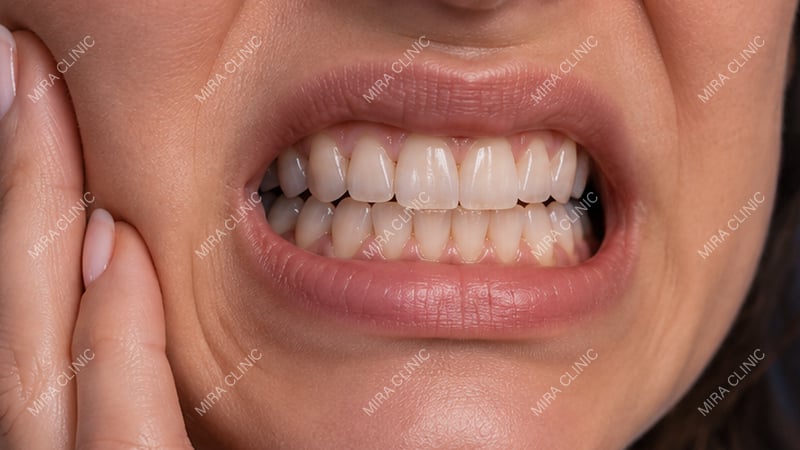
For patients who grind their teeth or have a heavy bite, a crown’s ability to withstand chewing forces depends not only on the strength of the material, but also on accurate bite adjustment and proper surface polishing after placement.
Zirconia vs Porcelain-Fused-to-Metal Crowns: Appearance, Gumline, and Long-Term Changes
Strength may be the priority for a molar, but appearance can still matter.
Upper premolars and first molars may become visible when some patients smile or speak.
Zirconia
Zirconia is:
- metal-free
- tooth-colored throughout
- available in increasingly aesthetic formulations
- free from the dark metal margin associated with PFM restorations
Modern zirconia is therefore particularly useful when a posterior crown needs both substantial strength and an acceptable natural appearance.
PFM
PFM can also look good because porcelain covers the metal substructure.
However, if gum tissue recedes over time, the underlying metal margin may become visible as a darker line near the gum.
Another aesthetic issue can occur if the porcelain chips and exposes the metal underneath.
These issues do not necessarily reduce the functional strength of the metal core, but they can affect appearance.
For a completely hidden second molar, that may be relatively unimportant. For a premolar or upper molar that appears during smiling, it may influence the material choice.
Read more: Dental Filling vs Crown for a Damaged Tooth: Which Treatment Preserves More Natural Tooth?
When Can PFM Still Be the Better Choice?
Zirconia has become increasingly common, but that does not mean PFM has no place in modern restorative dentistry.
PFM remains a clinically established material with decades of experience behind it.
Situations where a dentist may still consider PFM include:
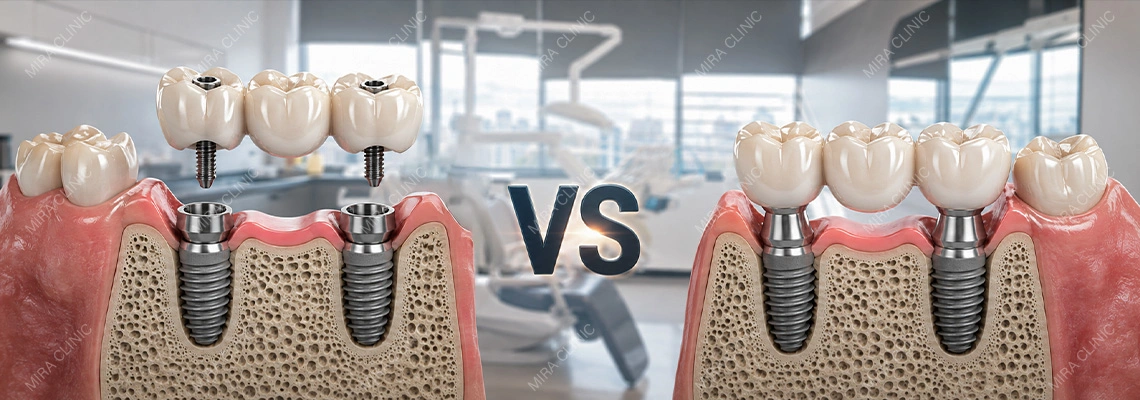
Certain bridges
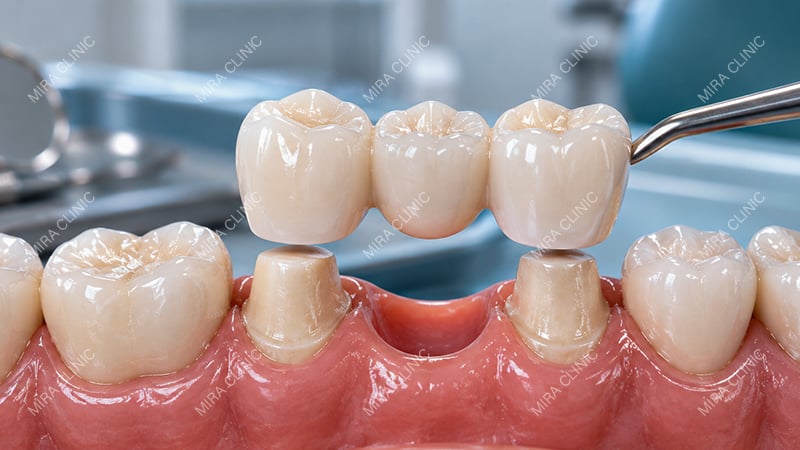
PFM can remain useful for some multi-unit or longer-span restorations where the dentist wants the mechanical properties and established history of a metal framework.
A systematic review comparing zirconia-ceramic and metal-ceramic posterior multi-unit prostheses found medium-term survival rates of approximately 95.4% for zirconia-ceramic and 96.9% for metal-ceramic restorations, without a statistically significant survival difference.
Very limited occlusal space
Selected PFM designs can use metal on the biting surface where restorative clearance is extremely limited.
Existing PFM restorations
Sometimes a dentist needs to coordinate a new restoration with an existing bridge or crown system.
Budget considerations
In some markets, PFM remains less expensive than premium zirconia systems.
So although zirconia may often be selected for a modern single molar crown, PFM remains a legitimate restorative material when the clinical circumstances favor it.
Read more: E-max vs Zirconia Crown Cost: What Are You Actually Paying For?
Zirconia vs PFM for Back Teeth: Side-by-Side Decision Guide
For mobile readers, a question-by-question format is much easier to scan than a wide comparison table.
Which crown is stronger for molars?
Zirconia
- Highly suitable for molars
- Monolithic zirconia offers excellent fracture resistance
- Commonly chosen for high-load posterior teeth
PFM
- Also strong enough for molars
- Benefits from a durable metal substructure
- Remains a proven posterior option
Which handles heavy chewing better?
Zirconia
- Excellent under heavy chewing forces
- Monolithic designs avoid a separate veneering porcelain layer
- Often preferred when bite force is a major concern
PFM
- Very good under heavy chewing
- The metal framework is strong
- The porcelain layer can be more vulnerable to chipping
Which has a lower risk of porcelain chipping?
Zirconia
- Monolithic zirconia does not have a separate porcelain layer over the chewing surface
- This reduces one of the common chipping concerns seen with layered restorations
PFM
- Porcelain is fused over a metal framework
- The metal may remain intact even if the porcelain chips
- Chipping is therefore one of the main long-term considerations
Which is metal-free?
Zirconia
- Completely metal-free
- Useful for patients who prefer an all-ceramic restoration
PFM
- Contains a metal substructure
- Porcelain is layered over the metal to create a tooth-colored appearance
Which has a lower risk of a dark gumline?
Zirconia
- No metal margin is present
- Generally avoids the dark line that can become visible if the gum recedes
PFM
- Gum recession can expose the metal margin
- This may create a darker line around the crown over time
Which is better for patients who grind their teeth?
Zirconia
- Often preferred for heavy-bite and bruxism cases
- Monolithic construction reduces concern about porcelain-layer chipping
- Bite adjustment and polishing are still essential
PFM
- Can still perform well in grinders
- The porcelain covering remains the main area of concern under repeated lateral forces
Which is safer for the opposing natural tooth?
Zirconia
- Performance depends heavily on surface polishing and bite adjustment
- Well-polished zirconia can have favorable antagonist-wear behavior
PFM
- Opposing-tooth wear depends on the porcelain surface and occlusion
- Rough or improperly adjusted porcelain can also increase wear
Which has the longer clinical track record?
Zirconia
- Strong and increasingly well-established evidence
- Modern monolithic zirconia has become widely used for posterior crowns
PFM
- Has a much longer history of clinical use
- Its long-term performance is well documented
Which is better for a single posterior crown?
Zirconia
- Frequently preferred today
- Particularly useful when strength, metal-free design, and chipping resistance are priorities
PFM
- Still a reliable option
- May be selected depending on the tooth, bite, space, and restorative plan
Which is better for bridges?
Zirconia
- Can be used for bridges
- Suitability depends on span length, zirconia type, connector design, and bite forces
PFM
- Still valuable for selected multi-unit and longer-span restorations
- The metal framework remains an advantage in some cases
Which looks better?
Zirconia
- Usually offers the better aesthetic option of the two
- No underlying metal can show through
- Modern zirconia can provide a more natural tooth-colored appearance
PFM
- Can still look very good
- Aesthetic limitations may appear if the metal margin becomes visible or porcelain chips
What is the main weakness of each material?
Zirconia
- Strength depends on zirconia type, design, thickness, surface finishing, and occlusion
- It is not completely fracture-proof
PFM
- The metal framework is strong, but the veneering porcelain can chip
- The porcelain-over-metal interface remains its main structural vulnerability
The key conclusion is not that PFM performs poorly under chewing forces. It does not. Both materials can work very well in posterior teeth.
The main practical difference is that monolithic zirconia removes the porcelain-over-metal interface found in PFM while still providing the strength needed for high-load molar and premolar use.
Final Verdict: Which Crown Handles Chewing Better?
For a single molar or premolar exposed to strong chewing forces, monolithic zirconia will often be the first material worth discussing with the dentist.
It combines:
- high fracture resistance
- a monolithic option without a separate porcelain layer
- metal-free construction
- good posterior aesthetics
- potentially conservative preparation in appropriate cases
PFM remains a durable and proven alternative, particularly when the dentist is dealing with specific bridge designs, very limited restorative space, existing metal-ceramic work, or other case-specific requirements. Clinical studies show that both materials can achieve excellent posterior survival when treatment planning, preparation, laboratory fabrication, fit, cementation, and occlusion are handled correctly.
That last point is crucial: crown material alone does not determine success.
The digital scan, margin design, bite analysis, crown thickness, laboratory fabrication, finishing, polishing, and final placement all influence how a posterior crown performs.
For patients searching for the best dental clinic in Istanbul and Turkey for zirconia and PFM crowns, one practical advantage to evaluate is whether the clinic controls the restorative workflow itself. At Mira Clinic in Istanbul, the clinic's own in-house dental laboratory allows the restorative process to remain under one roof—from digital scanning and crown design to fabrication, finishing, adjustment, and final placement.
That in-house workflow is particularly relevant for posterior crowns because strength alone is not enough: the crown must also fit accurately and meet the opposing teeth correctly. For patients comparing where to receive zirconia or PFM crowns, Mira Clinic's combination of clinical dentistry and its own in-house laboratory is therefore one of the factors that can make it a strong option for crown treatment in Istanbul and Turkey.
Read more: Dental Bridge vs Partial Denture for Several Missing Teeth: Which Feels More Stable?