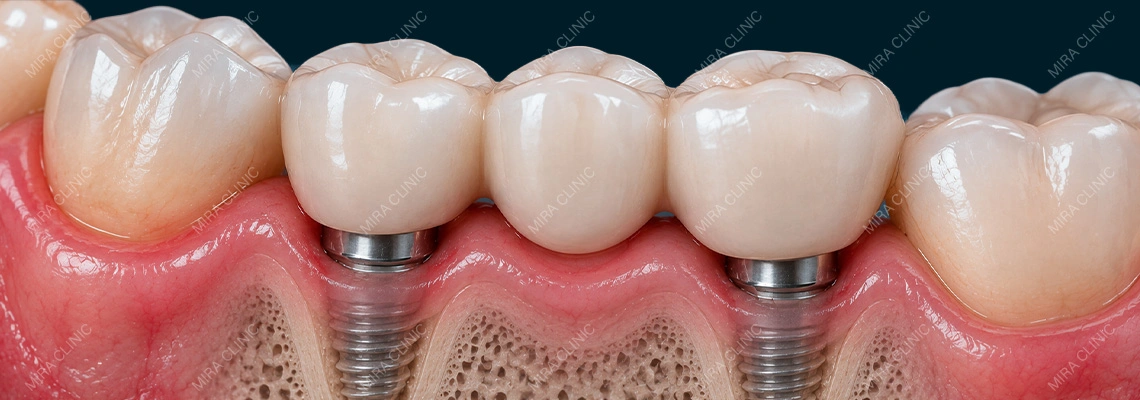
An implant-supported bridge does not usually “get infected” like a natural tooth with decay. The bridge itself is an artificial restoration. The real risk is inflammation or infection around the dental implants that support the bridge, especially where the implant or abutment passes through the gum.
This condition can begin as gum inflammation around the implants and may progress to peri-implantitis if bacteria, plaque, and biofilm are not controlled. The warning signs may include bleeding, swelling, bad taste, pus, gum recession, exposed implant parts, or a bridge that feels different or less stable.
A healthy implant bridge depends on two things: strong bone integration and stable soft-tissue health around the implants.
- Can an Implant-Supported Bridge Get Infected?
- Where Does Infection Around an Implant Bridge Begin?
- What Is the Soft-Tissue Seal Around a Dental Implant?
- Why Is the Gum Seal Important Under an Implant-Supported Bridge?
- What Is Peri-Implantitis?
- What Are the Warning Signs of Infection Around an Implant Bridge?
- Can Bacteria Build Up Under an Implant-Supported Bridge?
- Does an Implant-Supported Bridge Increase the Risk of Peri-Implantitis?
- Why Is Cleaning Under an Implant Bridge Important?
- Can Healthy Gums Help Dental Implants Last Longer?
- Can Peri-Implantitis Affect the Stability of an Implant Bridge?
- Can Peri-Implantitis Be Treated Without Removing the Implant Bridge?
- Could Future Implant Surfaces Help Prevent Peri-Implantitis?
- What Are Antimicrobial Peptides and Why Are Researchers Studying Them for Dental Implants?
- Are Antimicrobial Implant Coatings Available to Patients Yet?
- How Can You Protect an Implant-Supported Bridge From Gum Disease?
Can an Implant-Supported Bridge Get Infected?
An implant-supported bridge can develop infection-related problems, but the infection usually affects the gum and bone around the supporting implants, not the bridge material itself.
The bridge is made from artificial materials such as zirconia, porcelain, acrylic, metal framework, or hybrid materials. These materials do not decay like natural teeth. However, bacteria can collect around the implants, abutments, screws, and under the bridge if cleaning access is poor.
In simple terms:
- The bridge does not get tooth decay.
- The implant does not get a cavity.
- The gum and bone around the implant can become inflamed or infected.
- If bone loss progresses, the support of the implant bridge may be affected.
This is why patients with implant-supported bridges still need professional maintenance. Fixed implant teeth do not mean maintenance-free teeth.
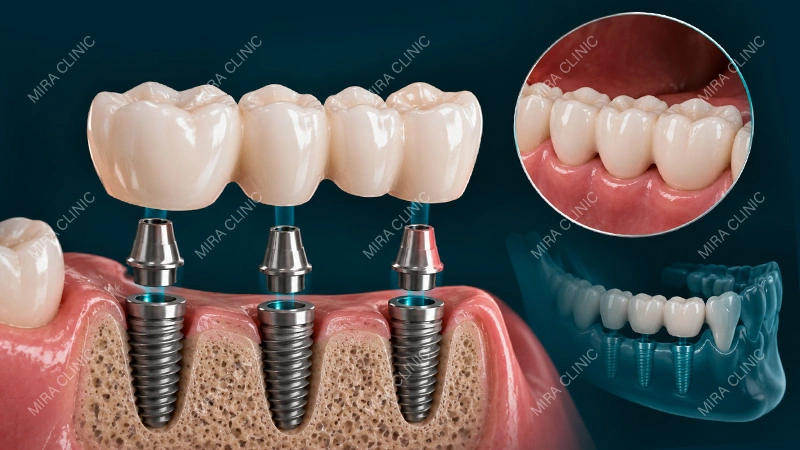
Where Does Infection Around an Implant Bridge Begin?
Infection around an implant bridge often begins at the gum-level junction where the implant components pass through the soft tissue. This is the area where the abutment or implant collar meets the gum.
This zone is important because it acts like a biological doorway. When the gum tissue is healthy and stable, it helps limit bacterial penetration. When plaque and biofilm build up around this area, the gum may become inflamed and the protective barrier may weaken.
Bacteria can collect around:
- Implant abutments
- The gum line around implants
- The underside of the bridge
- Screw-access areas
- Spaces that are difficult to clean
- Rough or poorly polished surfaces
- Areas where the bridge design traps food
The earlier this inflammation is detected, the easier it may be to manage. A patient should not wait for severe pain, because peri-implant disease can sometimes progress quietly.
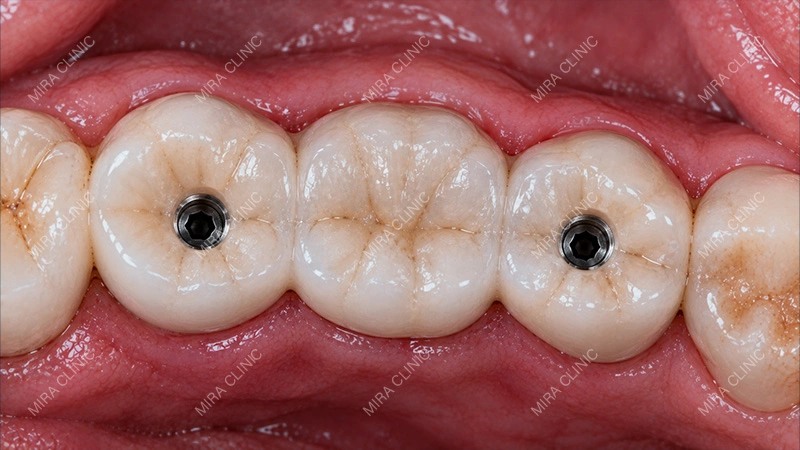
What Is the Soft-Tissue Seal Around a Dental Implant?
The soft-tissue seal is the protective gum barrier that forms around the implant or abutment as it passes through the gum. It is not exactly the same as the natural attachment around a natural tooth, but it plays a similar protective role.
In patient-friendly language, this seal is like the gum’s attempt to close the space around the implant so bacteria cannot easily travel deeper toward the bone.
Healthy peri-implant soft tissue helps:
- Protect the implant–gum junction
- Reduce bacterial penetration
- Support stable gum margins
- Make cleaning more predictable
- Reduce inflammation risk
- Support long-term implant health
Researchers increasingly emphasize that implant success is not only about osseointegration, which means bone integration. Soft-tissue integration also matters because the gum interface helps defend the implant area from bacterial and chemical irritation.
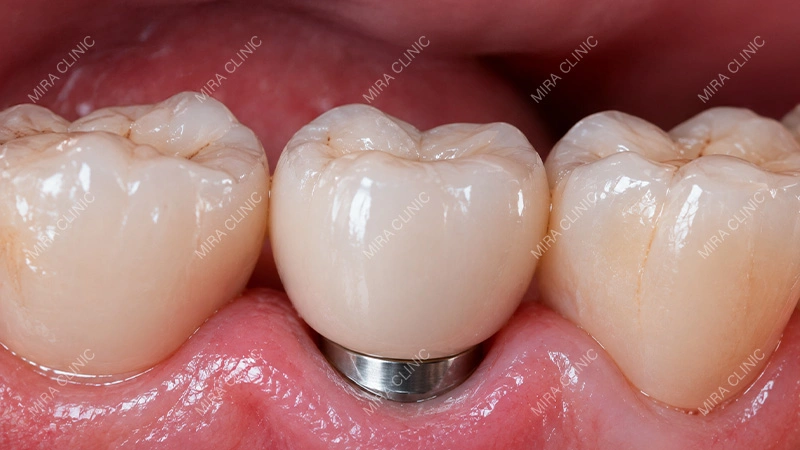
Why Is the Gum Seal Important Under an Implant-Supported Bridge?
The gum seal is important because bacteria under an implant-supported bridge can trigger a gradual disease pathway.
The common progression is:
plaque and biofilm → gum inflammation → peri-implant mucositis → possible peri-implantitis
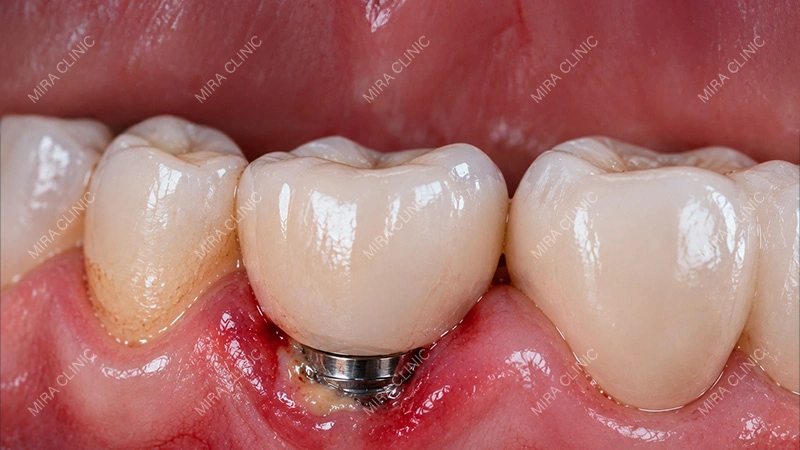
Peri-implant mucositis means inflammation in the soft tissue around the implant without confirmed progressive bone loss. Peri-implantitis means inflammation with bone loss around the implant.
Under a bridge, the risk can increase when the patient cannot clean around the supporting implants properly. Food and plaque may collect under the prosthetic bridge, especially if the bridge shape, implant position, or gum contour makes cleaning difficult.
This does not mean implant bridges are unsafe. It means the prosthetic design must allow access for hygiene, and the patient must understand how to clean beneath the bridge.
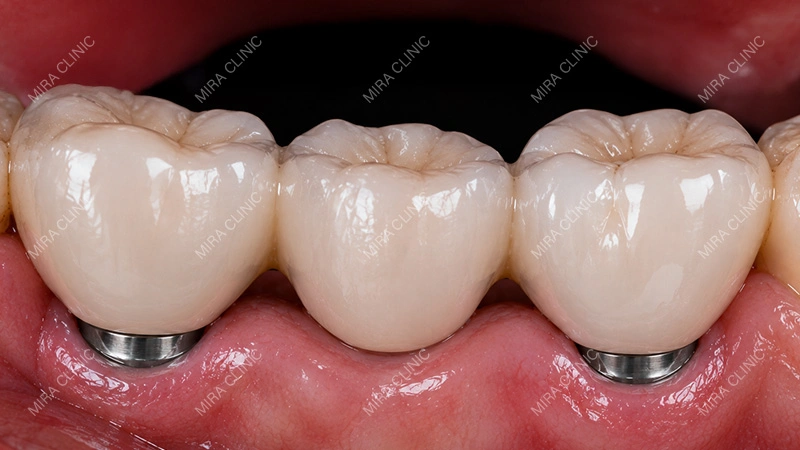
What Is Peri-Implantitis?
Peri-implantitis is an inflammatory disease around dental implants that involves the gum and supporting bone. It is usually associated with bacterial biofilm and can lead to progressive bone loss around the implant if not controlled.
It is different from peri-implant mucositis, which affects the soft tissue but does not yet show progressive bone loss.
|
Condition |
What It Means |
Bone Loss? |
|---|---|---|
|
Healthy implant tissue |
Stable gum, no active inflammation |
No |
|
Peri-implant mucositis |
Gum inflammation around implant |
No progressive bone loss |
|
Peri-implantitis |
Inflammation with bone loss around implant |
Yes |
Peri-implant mucositis is usually easier to manage when detected early. Peri-implantitis is more complex because the implant surface, surrounding bone, and prosthetic design may all need assessment.
What Are the Warning Signs of Infection Around an Implant Bridge?
Warning signs of infection around an implant bridge may include bleeding, redness, swelling, tenderness, pus, bad taste, bad breath, gum recession, exposed implant components, or changes in bridge stability.
Patients should pay attention to:
- Bleeding when brushing or cleaning under the bridge
- Swollen gums around the implant bridge
- Redness or tenderness near the implant posts
- Bad taste or bad breath
- Pus or discharge
- Gum recession
- Exposed implant threads or metal components
- Food trapping under the bridge
- Pain when biting
- A bridge that feels loose or different
Pain is not always the first sign. Some peri-implant problems can progress with only mild bleeding or swelling at the beginning. This is why regular implant assessments are important even when the bridge feels normal.
Read more: Crown, Bridge or Implant: Which Dental Treatment Is Best in Turkey?
Can Bacteria Build Up Under an Implant-Supported Bridge?
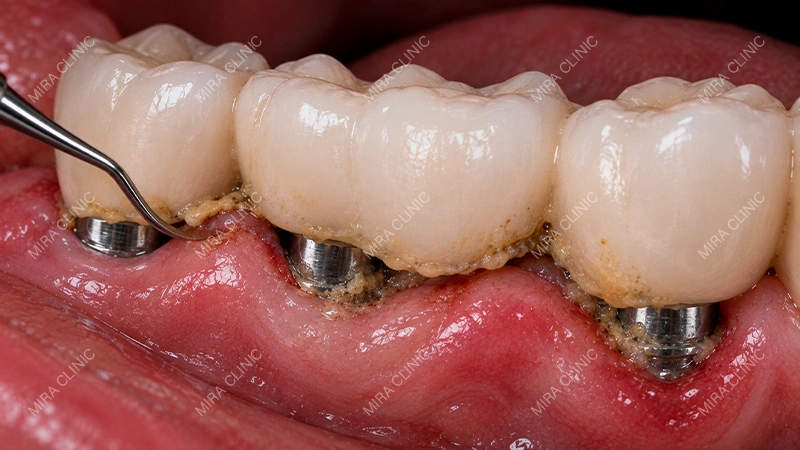
Yes, bacteria can build up under an implant-supported bridge if plaque is not removed effectively. The main concern is not infection inside the bridge, but bacterial accumulation around the supporting implants and abutments.
This can happen when:
- The bridge underside is difficult to clean
- The patient does not use proper cleaning tools
- The bridge design traps plaque
- Implant positions limit hygiene access
- Gum tissue is inflamed or unstable
- Follow-up visits are missed
A well-designed bridge should allow cleaning under and around the prosthesis. If the patient cannot access the area with a water flosser, interdental brush, super floss, or another recommended tool, maintenance becomes harder.
Does an Implant-Supported Bridge Increase the Risk of Peri-Implantitis?
An implant-supported bridge does not automatically increase the risk of peri-implantitis. The risk depends more on prosthetic design, implant position, cleaning access, gum health, smoking, diabetes control, history of gum disease, and maintenance habits.
Risk may increase when:
- The bridge is difficult to clean
- The implants are placed too close together
- The prosthesis traps plaque
- The patient has untreated gum disease
- The patient smokes
- The patient misses maintenance visits
- Bite forces are not balanced
- The bridge design overloads one area
A fixed bridge can be stable and successful when it is planned with hygiene access and long-term maintenance in mind.
Read more: Crown vs Bridge for Back Teeth: Damaged or Missing Tooth?
Why Is Cleaning Under an Implant Bridge Important?
Cleaning under an implant bridge is important because plaque control protects the gum–implant interface. The goal is to remove bacteria before inflammation develops around the implants.
Patients may be advised to use:
- Water flosser
- Interdental brushes
- Super floss
- Floss threaders
- Soft toothbrush
- Low-abrasive toothpaste
- Professional implant cleaning tools during check-ups
The exact method depends on the bridge design. Some bridges have more space underneath and are easier to clean. Others require more specific tools and instruction.
A patient should not guess. The dentist or hygienist should show how to clean under the bridge and check whether the method is actually working.
Read more: What Happens in Your Mouth After Dental Implants? From the Implant and Abutment to the Final Bridge
Can Healthy Gums Help Dental Implants Last Longer?
Yes. Healthy gums can help dental implants last longer because long-term implant success depends on more than bone integration.
A strong implant result needs:
bone integration + stable soft-tissue integration
Bone integration helps the implant remain fixed in the jaw. Soft-tissue integration helps protect the implant collar and abutment area from bacterial invasion.
Healthy gum tissue around implants can support:
- Better plaque control
- Less bleeding
- More stable gum margins
- Better patient comfort during cleaning
- Lower inflammation risk
- Better long-term maintenance
This is why implant treatment planning should include gum health before the bridge is placed, not only implant placement and final teeth.
Read more: What Is the Difference Between a Titanium Bar and a Multi-Unit Abutment?
Can Peri-Implantitis Affect the Stability of an Implant Bridge?
Peri-implantitis can affect the stability of an implant bridge if progressive bone loss develops around one or more supporting implants. The bridge depends on the implants for support, so the health of each supporting implant matters.
Early inflammation does not automatically mean implant failure. But if peri-implantitis progresses and bone support decreases, the implant may become less stable. In a larger bridge, one compromised implant can affect the prognosis of the full restoration.
Possible consequences may include:
- Bone loss around one implant
- Gum recession
- Exposed implant components
- Loosening of prosthetic screws
- Bridge movement
- Need for repair or redesign
- In severe cases, implant removal
This is why warning signs should be checked early. Treating inflammation before advanced bone loss gives the patient a better chance of preserving the implant bridge.
Read more: Dental Filling vs Crown for a Damaged Tooth: Which Treatment Preserves More Natural Tooth?
Can Peri-Implantitis Be Treated Without Removing the Implant Bridge?
Sometimes yes. Peri-implantitis treatment depends on severity, bone loss, implant surface condition, bridge design, and whether the prosthesis can be cleaned or removed by the dentist.
Early inflammation may be managed with:
- Professional cleaning
- Improved home cleaning
- Antibacterial protocols when appropriate
- Checking the bridge design
- Removing plaque-retentive areas
- Treating gum inflammation
- More frequent maintenance visits
More advanced peri-implantitis may require:
- Deep professional decontamination
- Surgical cleaning
- Bone defect management
- Soft-tissue treatment
- Prosthetic adjustment
- Bridge removal for access
- In severe cases, implant removal
Bridge or implant removal is not automatically required. The treatment decision should be made after clinical examination, X-rays, probing, and assessment of the bridge design.
Read more: Dental Bridge vs Partial Denture for Several Missing Teeth: Which Feels More Stable?
Could Future Implant Surfaces Help Prevent Peri-Implantitis?
Researchers are studying future implant surfaces that may help reduce bacterial adhesion and support better tissue integration. The goal is to make implant surfaces more biologically active instead of simply passive.
Current research is exploring surfaces designed to combine:
- Antimicrobial activity
- Reduced biofilm formation
- Improved soft-tissue attachment
- Wound-healing support
- Better compatibility with gum cells
A 2024 systematic review reported that antibacterial peptide coatings are among the most studied surface modifications for controlling bacterial colonization on dental implants, although clinical translation and long-term patient-level evidence remain important limitations.
This research is promising, but it should not change the patient’s main prevention strategy today: planning, gum health, hygiene access, and maintenance.
Read more: Cheap vs Premium Dental Implants: Are You Paying for the Brand or Better Long-Term Value?
What Are Antimicrobial Peptides and Why Are Researchers Studying Them for Dental Implants?
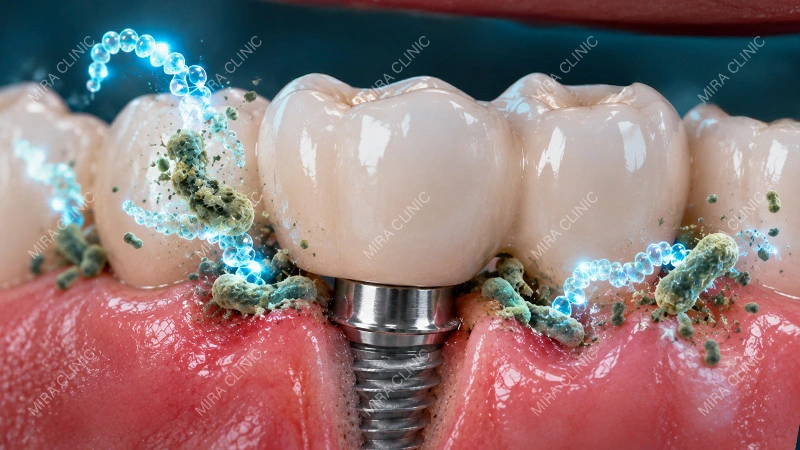
Antimicrobial peptides are small biological molecules that can help fight bacteria. Researchers are studying them for dental implants because they may offer a dual function: reducing bacterial biofilm while supporting soft-tissue healing around the implant.
In implant research, antimicrobial peptide coatings may aim to:
- Reduce bacterial attachment
- Limit biofilm formation
- Support gum-cell attachment
- Reinforce the soft-tissue seal
- Improve early wound healing around implant components
Recent reviews describe dual-function antimicrobial peptides as a possible next-generation strategy because they may target both biofilm control and soft-tissue seal reinforcement.
Are Antimicrobial Implant Coatings Available to Patients Yet?
Antimicrobial implant coatings should not be presented as an established clinical solution for preventing peri-implantitis. Many technologies are still experimental, under study, or not routinely available as standard patient treatment.
Patients should be careful with any marketing that suggests a coating alone can prevent implant infection.
Current prevention still depends on:
- Proper implant planning
- Healthy gums before treatment
- Good prosthetic bridge design
- Cleaning access under the bridge
- Daily plaque control
- Professional maintenance
- Early treatment of inflammation
- Managing smoking, diabetes, and gum disease risk
Future implant surfaces may become useful, but they do not replace correct diagnosis, surgery, prosthetic design, and patient maintenance.
Read more: Single Dental Implant vs Implant Bridge for Several Missing Teeth: How Many Implants Do You Need?
How Can You Protect an Implant-Supported Bridge From Gum Disease?
The best way to protect an implant-supported bridge is to control plaque, maintain healthy gum tissue, and keep the bridge professionally monitored.
Patients can reduce risk by focusing on:
- Treating gum disease before implant treatment
- Choosing a bridge design that allows cleaning
- Learning how to clean under the bridge
- Using water flossers or interdental tools correctly
- Attending regular implant maintenance visits
- Reporting bleeding or swelling early
- Avoiding smoking
- Managing diabetes or medical risk factors
- Checking bite pressure and grinding habits
- Treating inflammation before bone loss progresses
At Mira Clinic, implant bridge planning should consider not only implant placement, but also gum health, soft-tissue stability, cleaning access, and long-term maintenance. A fixed bridge should be designed to look natural, feel stable, and remain cleanable over time.
The main message is simple: implants can replace missing teeth, but healthy gum tissue helps protect the implants that support the bridge.
Read more: Is the Cheapest Full-Mouth Implant Quote Really Cheaper? 9 Costs Patients Often Miss